
Using “AI” as the primary product promise increases expectation risk. The term names a research field, a broad class of software, a marketing badge, and a set of social claims about work and human capability. Those meanings do not imply the same reliability, autonomy, understanding, or consequences.
The problem is not AI itself. It is what the label makes users infer when the product description leaves the mechanism unstated. A system that classifies documents, predicts demand, generates text, or routes exceptions may be useful without understanding, deciding, or learning in the human sense. Calling it “AI-powered” first encourages buyers to supply their own interpretation—and to judge the product against a promise the team never defined.
Effective AI product positioning leads with the behavior: what the system does, for which inputs, and with what result. It then states operating limits, failure handling, and the human role. Keep “AI” as secondary context when it helps discovery or identifies a meaningful category. Do not make two letters carry the value proposition.
What does the AI label promise to users?
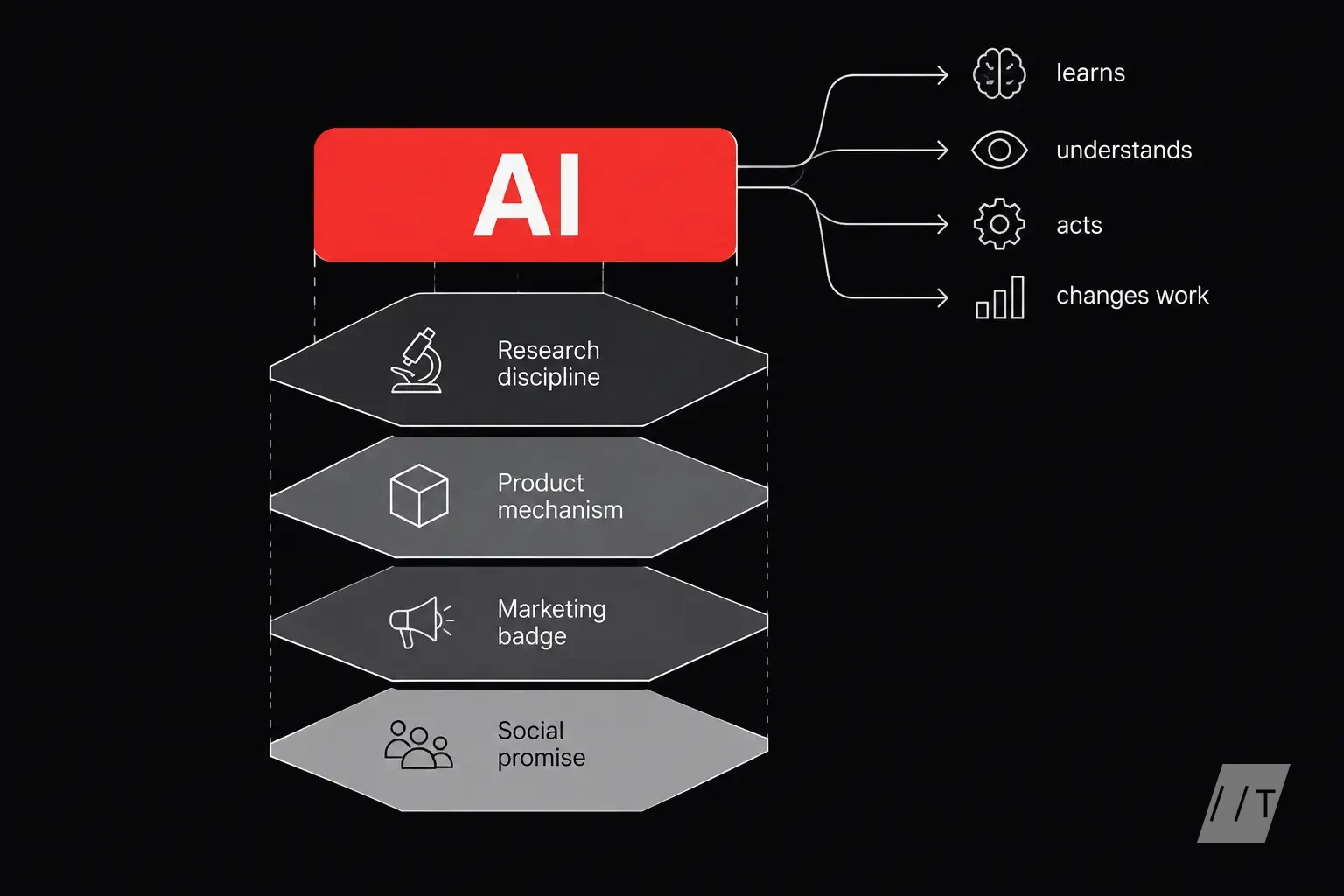
“AI” compresses four different meanings into one product label, and each one sets a different expectation.
First, it names a research field: computer science and engineering concerned with systems that perform tasks associated with human intelligence, including learning, perception, reasoning, and decision-making. In that context, the word signals an area of technical work, not a finished capability.
Second, it names a broad product category. Search ranking, recommendation, fraud detection, image enhancement, chatbots, and workflow automation can all be described as AI products. Buyers may reasonably infer that the system adapts beyond fixed rules, but the label does not say how.
Third, it operates as a marketing badge. “AI-powered” can mean little more than “software containing a model,” while signaling modernity, sophistication, or investment worthiness. That badge says the product belongs to a desirable category without specifying its behavior.
Fourth, AI is shorthand for social claims about work, education, inequality, and human-like capability. Public discussion turns a feature label into predictions about job displacement, transformed classrooms, or machines that understand and act independently.
These meanings pull expectations in different directions. Users may expect high reliability from a product category, autonomy from the language of intelligence, understanding from human-centered metaphors, and broad social consequences from the public debate. A product team that says only “AI” leaves all four interpretations active—and none of them defines what the product actually does.
Why does one label create expectation risk?
“AI” creates expectation risk because users supply the missing specification themselves. The label does not say whether a product predicts, matches patterns, generates content, or automates a workflow. Instead, people often infer human-like capabilities: that the system understands context, learns from experience, or decides responsibly.
Product language can intensify that gap. A classifier becomes a system that “understands” documents. A model updated with labeled examples “learns.” A workflow that selects from predefined actions “decides.” These verbs are not harmless shorthand when they imply capabilities the product does not provide. Understanding suggests meaning beyond surface patterns; learning suggests transferable improvement; deciding suggests judgment and accountability.
Disappointment follows when the system meets its actual operating boundary. A generated answer may sound coherent but contain an error. A prediction may fail outside its training distribution. An automated workflow may follow its configured path but mishandle an exception. The user experiences this not as a narrow model limitation, but as a broken promise.
Broad claims are also difficult to test and support. Teams cannot evaluate “understands” without defining inputs, outputs, conditions, and acceptable error. Buyers cannot compare two products that use the same label for different mechanisms. Support teams cannot diagnose a failure against a measurable commitment, and product leaders have little defensible language when observed behavior falls short.
The practical fix is to name the behavior first: classify these records, extract these fields, draft this response, or route this exception. Then state the conditions, limits, and human checkpoint. “AI” can describe the method; it should not define the promise.
When does AI become marketing jargon?
“AI” is functioning as marketing jargon when it names the feature instead of describing what the product does. Three tests make that visible:
- Headline test: the page leads with “AI-powered” while postponing the user’s task or result.
- Deletion test: remove “AI” and nothing remains that says what changes for the user.
- Specificity test: the claim avoids naming the inputs, the operation, the conditions, or the human role.
“AI-powered insights” fails all three. It does not say whether the system classifies records, predicts demand, summarizes documents, or recommends an action. It also leaves unanswered when the feature works, how errors appear, and who reviews the result.
That does not make every broad use deceptive. “AI” can provide legitimate category context when buyers already understand the product area—such as a machine-learning platform or an AI model hosting service. In those cases, the label helps discovery, but it still does not replace the product claim.
AI washing begins when the badge supplies the substance: a familiar workflow is renamed without explaining a changed capability, or human-like verbs conceal narrower mechanisms. Product leaders should treat the label as secondary context and lead with an observable behavior, measurable outcome, operating limits, and named human checkpoint.
“AI” still has value, but it should not carry the product promise
The strongest case for keeping “AI” is practical: it is a compact category signal. Buyers searching for systems that adapt beyond fixed rules may use the term to find relevant products. Investors, analysts, and technical teams may also need it to distinguish learned or generative systems from conventional automation. Removing the label entirely can make discovery harder and hide a meaningful difference in how a product behaves.
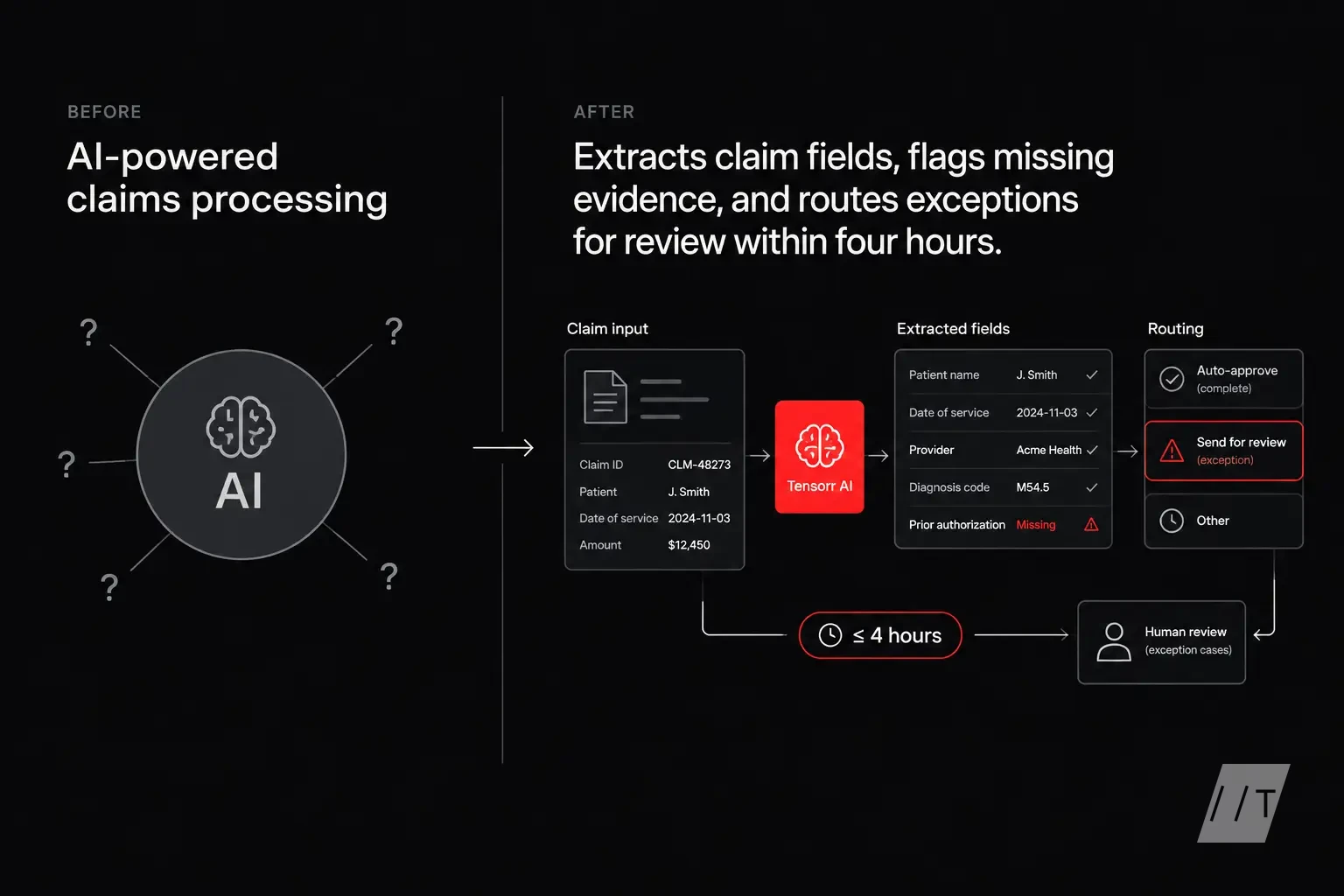
That value is contextual, not descriptive enough to lead. “AI” can attract attention and suggest adaptability, but it does not tell a buyer which task changes, what inputs the system uses, or where human judgment remains necessary. A product page that says only “AI-powered claims processing” makes the buyer infer the rest. Those inferences may include reliable understanding, independent decisions, or broad automation that the system cannot provide.
The better position is to keep the term as secondary context: “Extracts claim fields and flags missing evidence using machine learning.” The first clause names the value; the second explains the method for readers who care about it.
This rule has a boundary. If a defined audience shares a stable technical meaning of “AI”—for example, a specialist buyer evaluating model-based systems—and the claim pairs the label with measurable scope, leading with it can work. The scope still has to be concrete: inputs, outputs, accuracy, latency, operating conditions, and human checkpoints. “AI” may identify the category. It should not substitute for the contract.
Which technical behaviors should replace broad AI language?
Replace anthropomorphic verbs with operations a buyer can observe and test. “Understands” should become “classifies documents” or “extracts these fields from these inputs.” “Learns” should specify the mechanism: “updates from labeled examples” or “personalizes recommendations from usage.” “Reasons” should become “selects among defined steps under stated constraints.” “Autonomous” should name the authority granted: “executes these actions without approval, except at the listed checkpoints.”
A usable claim also states its operating boundary. Name the supported input formats and data sources, the expected accuracy or error rate, and the latency target. Say what happens when confidence is low: reject the item, request more information, or escalate it to a person. State whether customer data is retained, whether the system can access external tools, and which actions it cannot take. Failure recovery belongs in the promise too—for example, retrying a failed API call, preserving a draft, or routing an unresolved case to an operator.
| Vague claim | Testable replacement |
|---|---|
| Understands invoices | Extracts vendor, date, total, and line items from PDF invoices |
| Learns your preferences | Personalizes recommendations from saved ratings and recent usage |
| Reasons about cases | Applies these eligibility rules and flags exceptions for review |
| Works autonomously | Sends approved follow-ups and escalates low-confidence cases |
These formulations may sound narrower, but that is the point. Narrow claims support evaluation, service-level targets, and clear responsibility. “AI” can describe the implementation in secondary context; the primary promise should describe what the system does, where it stops, and who takes over.
How can a product claim avoid overpromising?
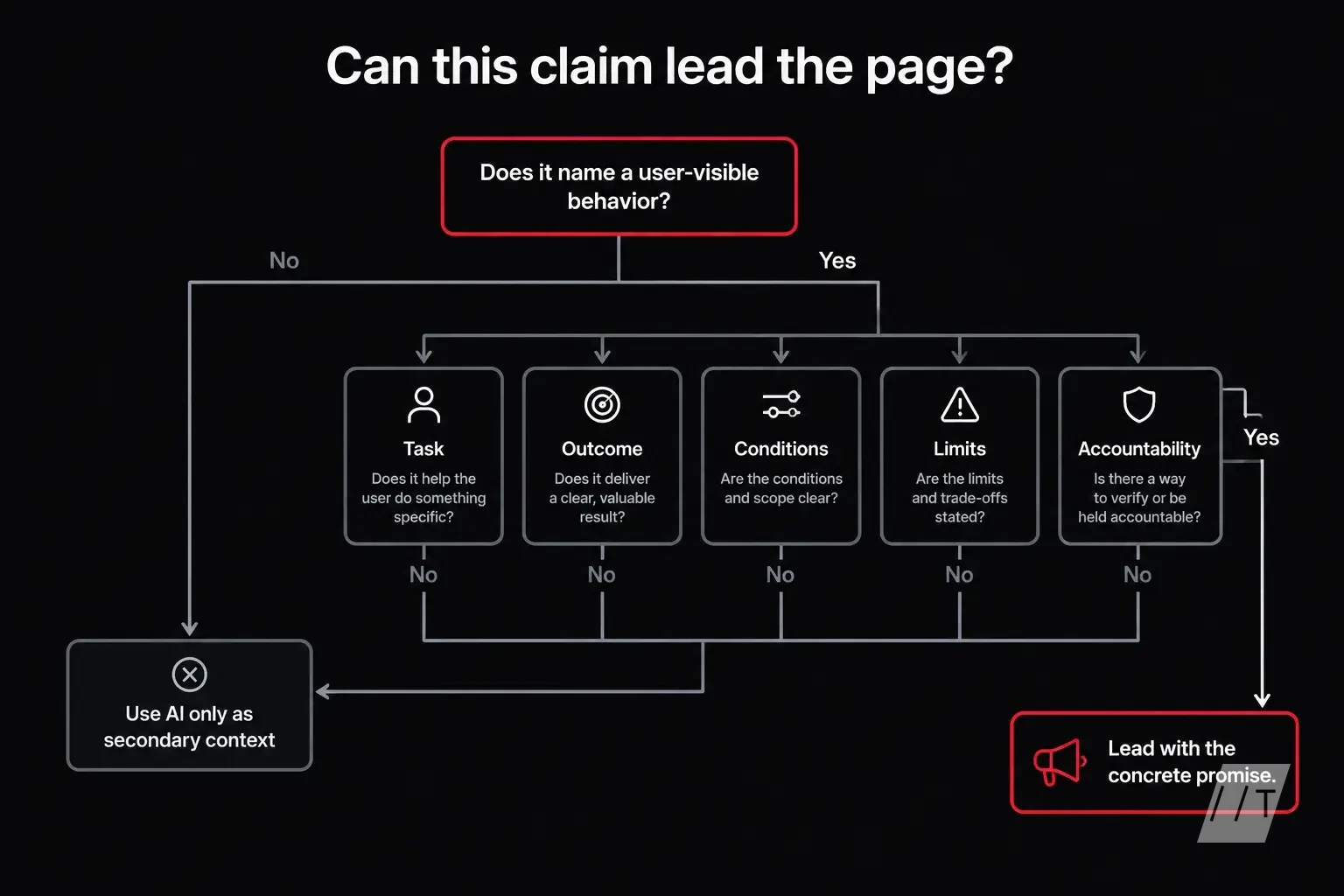
A defensible claim names the task, evidence, boundary, and accountable human—not merely the model category. Use this worksheet before publishing an AI product positioning statement:
| Claim element | Question to answer | Example |
|---|---|---|
| Broad label | What category term are we tempted to lead with? | AI assistant |
| Observable verb | What does the system visibly do? | Extracts and summarizes |
| Input | What data does it receive? | Uploaded support tickets |
| Output | What result does it produce? | A draft response and cited fields |
| Operating conditions | Where and when does it work? | English tickets under 10,000 characters |
| Confidence or error behavior | What happens when it is uncertain? | Flags low-confidence fields |
| Human responsibility | Who reviews or approves the result? | An agent approves before sending |
| Non-capabilities | What must users not infer? | It does not contact customers or resolve disputes |
A useful rewrite turns “Our AI assistant resolves customer issues” into: “Classifies incoming English-language tickets, drafts a response with cited account fields, and flags uncertain cases for agent approval within 30 seconds. It does not send messages or make refunds.” The second claim can be tested against latency, classification accuracy, escalation rates, and the stated human checkpoint.
Apply a deletion test: remove “AI” from the sentence. What remains should still name a verb, a result, and a timeframe. If deleting the label leaves only “helps teams work smarter,” the page has described a badge rather than a product behavior. Keep “AI” as secondary context when it helps buyers locate the category; make the observable promise carry the decision.
What should product leaders decide before using AI in the headline?
Product leaders should lead with the job completed and the measurable outcome, not the method used to produce it. Add “AI” only when the technical category changes a buyer’s decision—for example, when adaptive behavior matters and the audience shares a stable definition. Publish the operating boundaries: supported inputs, accuracy or failure conditions, latency, data limits, and the points where a person reviews or takes over. Then validate the claim against observed product behavior, not roadmap intent; a planned capability cannot support today’s promise.
Use a simple operating rule: if removing “AI” leaves no clear verb, result, timeframe, or accountability, the headline is carrying too much weight. Users should be able to connect every promise to a specific behavior and a stated limit.