
Durable AI savings do not come from attaching a tool to existing work. They come from redesigning the workflow—and the operating model around it—so that AI changes how work is routed, decided, completed, and measured.
The performance gap is material: AI leaders achieve roughly three times greater cost reduction than laggards. The difference is not simply model quality or the number of pilots launched. Organizations that treat AI as a standalone initiative tend to preserve the same handoffs, queues, controls, and role boundaries, capturing isolated productivity gains while leaving the underlying cost structure intact. Leaders make AI part of the way the business is designed and run.
That requires a practical sequence. First, concentrate investment on a small number of high-impact use cases. Then establish the data, technology, integration, security, and ownership foundations needed to operate them reliably. Next, reinvent the workflows and operating model end to end—not just the task performed by a person or system. Finally, combine AI with complementary cost levers, such as simplification and offshoring, to generate near-term savings and fund deeper reinvention. The objective is not to deploy more AI; it is to change the economics of the work.
Why Conventional AI Cost Programs Underperform
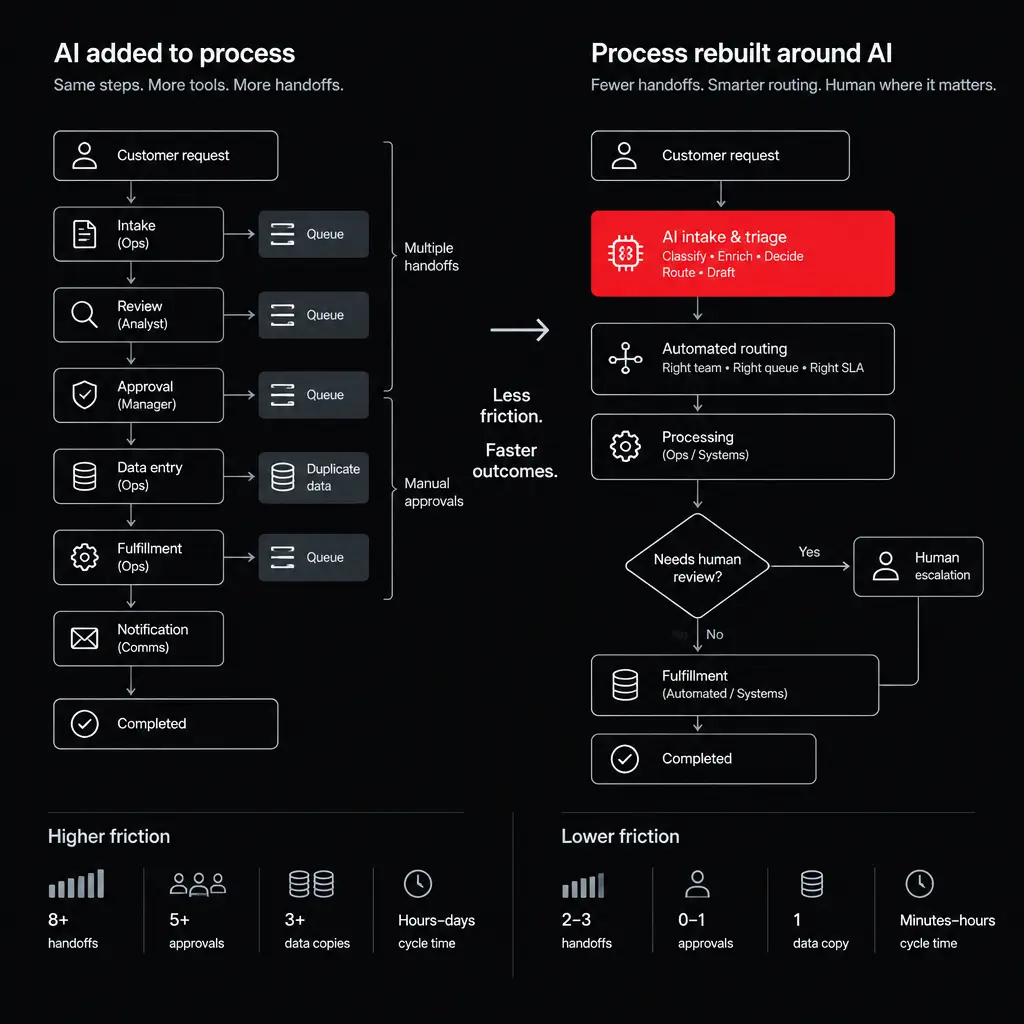
Most AI cost programs start too locally. A team pilots a copilot, deploys a point solution, or automates one step in an existing process. The tool may improve that step, but the surrounding workflow stays intact: the same handoffs, approval layers, roles, queues, and service model remain in place.
That structure limits the economics. A faster first step does not necessarily reduce end-to-end cost if the output still waits for a downstream review, is re-entered into another system, or requires a second team to validate it. Productivity gained in one activity can be absorbed by duplicated work, exception handling, reconciliation, and manual escalation. The organization may process more work without changing its underlying cost base.
Point solutions also create their own overhead. Each deployment can require separate data access, controls, vendor management, training, monitoring, and support. As the number of pilots grows, governance becomes fragmented and employees must learn which tool applies to which task. The result is a larger technology estate without a simpler operating model.
Automation layered onto unchanged work is therefore not the same as redesign. It preserves the assumptions built into the old process: why an approval exists, which team owns a decision, where information is stored, and when a case is escalated. Some of those assumptions may no longer be necessary once AI can classify work, recommend decisions, or route exceptions. Leaving them untouched captures only local efficiency while organizational complexity remains fixed.
The practical test is end to end: does the intervention remove work, reduce handoffs, change capacity requirements, or improve the economics of the complete service? If it only makes one task faster while every downstream obligation survives, the apparent saving is likely to be productivity in place—not structural cost reduction.
Start With a Small Portfolio of Material Workflows
The first leadership decision is where not to invest. Do not spread AI funding across every team, process, and proof of concept. Select a small portfolio of workflows where improvement can materially change the cost base or the experience delivered to customers and employees.
Prioritize candidates against six practical questions:
- Cost base: How much labor, vendor spend, rework, or failure demand does the workflow consume?
- Transaction volume: Is the work frequent enough for small improvements to compound?
- Repeatability: Are the inputs and steps sufficiently consistent to support automation or decision assistance?
- Decision complexity: Can rules handle much of the work, or can AI reduce the effort required for judgment-heavy decisions?
- Business impact: Would a better process improve customer outcomes, employee capacity, risk, or revenue—not just task-level productivity?
- Feasibility: Are the data, systems, controls, and process ownership available to deliver a result within a credible timeframe?
The best candidates are not always the easiest demonstrations. A low-effort use case with little volume may produce an attractive pilot but no meaningful economics. Conversely, a large workflow may justify investment even when it requires integration, policy changes, or redesigned controls. The portfolio should balance near-term feasibility with enough economic weight to matter.
A focused portfolio also creates a learning system. Teams can establish baselines, measure end-to-end outcomes, identify failure modes, and reuse patterns for data access, orchestration, security, and human review. Each successful workflow makes the next one cheaper and faster to design. Scattered experiments do the opposite: they duplicate infrastructure, produce incomparable metrics, and leave no clear owner accountable for benefits.
Set explicit selection criteria and assign an accountable business owner before development begins. Measure the workflow’s full economics— including handoffs, exception handling, quality checks, and downstream rework—rather than reporting model accuracy or hours saved in isolation. The objective is not to maximize the number of AI use cases. It is to build a concentrated set of redesigned workflows that can demonstrate measurable cost and operating impact.
Build the Foundations Before Scaling
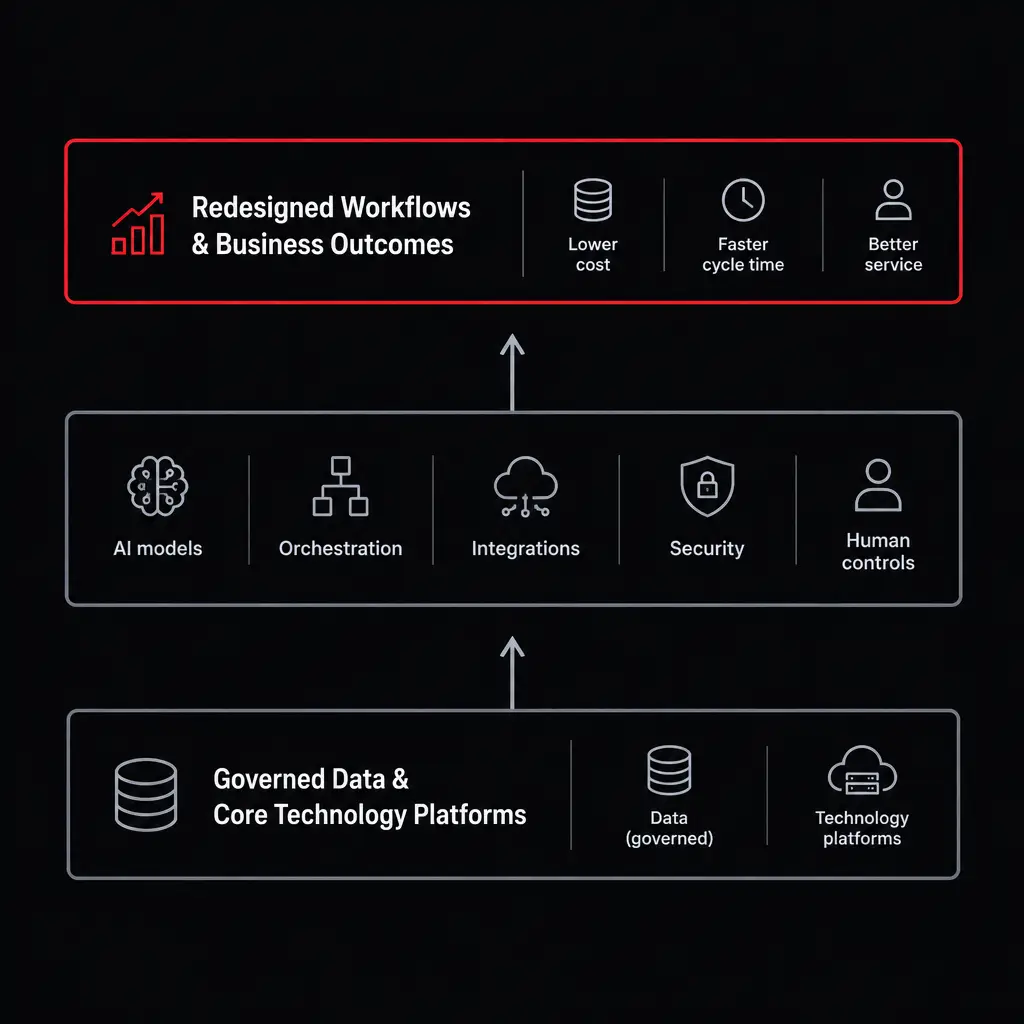
A capable model cannot compensate for weak operating infrastructure. Scaling AI requires reliable, accessible data; an architecture suited to the workload; integrations with the systems where work is performed; and security and controls that hold up in production.
Data must be discoverable, current, well-defined, and governed. Fragmented records, inconsistent definitions, and undocumented process logic make even accurate model outputs difficult to trust or use. Teams then spend their time reconciling inputs instead of improving the workflow.
The technology architecture also needs a clear path from model output to action. AI may classify a case, recommend a decision, or draft a response, but the result has limited value if it cannot update the relevant case-management, finance, service, or operations system. Integration is therefore part of the use case, not a later implementation detail. Fit-for-purpose orchestration, monitoring, access controls, audit trails, and human review points determine whether the capability can operate safely at volume.
Ownership must be explicit. Business leaders should own the outcome and process design; technology and data teams should own the platforms and interfaces; risk, security, and compliance functions should define controls proportionate to the use case. Without clear accountability, pilots accumulate while nobody is responsible for data quality, exception handling, model performance, or the economics of the live process.
The practical test is simple: can the organization provide the right information, produce a dependable output, route it into the system of record, and govern what happens when the model is wrong or uncertain? If not, adding model capability will create another disconnected layer rather than scalable cost reduction.
Reinvent the Workflow, Not Just the Task
The largest gains come from redesigning the process from trigger to outcome. Leaders examine what starts the work, which decisions can be automated, which require AI-assisted judgment, how exceptions are routed, and where a human must remain accountable. They remove unnecessary handoffs and queues instead of making each existing step slightly faster.
That requires a different operating model, not merely a new software deployment. Roles change as people move from routine execution to exception handling, judgment, and relationship management. Skills must shift toward process ownership, data interpretation, and supervising automated decisions. Incentives should reward end-to-end outcomes rather than local activity, and governance must define when AI can act, when it must ask for review, and how errors are detected and corrected.
Measurement also has to follow the redesigned workflow. Track cycle time, cost per completed outcome, exception rates, rework, service quality, and the share of work completed without manual intervention. A model can improve accuracy or productivity at one step while the overall process remains expensive because downstream review, reconciliation, or escalation is unchanged. Accountability therefore belongs with an owner of the full outcome, supported by operational controls and continuous monitoring.
The hard question is not whether AI can perform a task. It is whether the organization is willing to change the sequence of work, decision rights, roles, and controls around that capability. Without those changes, AI remains a faster component inside an unchanged system—and the system keeps most of its original cost.
Pair AI with complementary cost levers
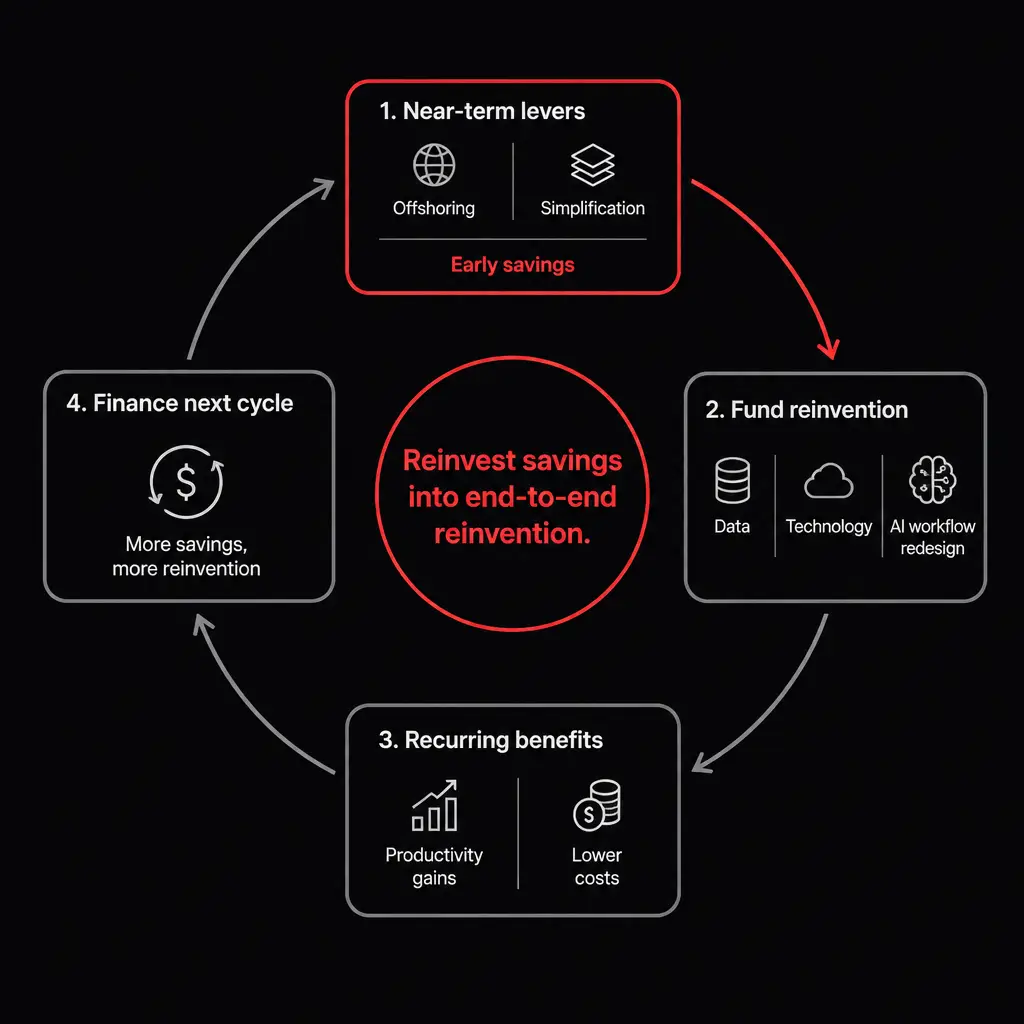
AI is not the only way to take cost out of a workflow, and it is rarely the fastest first move. Offshoring, shared services, vendor renegotiation, span-of-control changes, and straightforward process simplification can produce earlier savings. Those savings create financial room to fund better data, system integration, and the deeper workflow redesign that AI requires.
The relationship also runs in the other direction. As AI changes the amount and type of work required, it can alter which activities belong in a service center, which can be handled locally, and where specialized judgment is needed. A process that once required a large offshore operations team may eventually need fewer people performing narrower exception and oversight roles. The right location and staffing model should therefore be reassessed as the workflow changes, not treated as a permanent design choice.
Combining levers does not make redesign optional. Moving work to a lower-cost location while keeping the same handoffs, approvals, data entry, and exception paths preserves the underlying complexity. It may lower the unit cost temporarily, but it also leaves more interfaces for AI to navigate and more coordination to manage. Traditional measures should simplify the process and fund reinvention—not become a substitute for it.
Turn AI Cost Reduction Into an Operating Advantage
Use this checklist to test whether an AI cost program can produce durable results:
- Choose a small number of material workflows. Prioritize work with a meaningful cost base, high volume, repeatable decisions, and clear customer or employee impact. A short portfolio makes results measurable and exposes what the organization needs to learn.
- Measure economics end to end. Include labor, technology, rework, exceptions, handoffs, approvals, controls, and service outcomes. A faster task is not a saving if duplicated work or downstream handling remains unchanged.
- Build the foundation before scaling. Make the required data reliable and accessible. Integrate AI with the systems where work is completed, and establish security, controls, and accountable ownership. Model capability alone does not overcome fragmented information or undocumented processes.
- Redesign roles and controls with the workflow. Define which decisions AI can automate, which require human judgment, how exceptions escalate, and how performance is monitored. Update skills, incentives, governance, and accountability at the same time.
- Combine AI with complementary levers. Simplification, offshoring, and other conventional measures can deliver earlier savings and create room for deeper reinvention. They should reduce complexity, not merely move unchanged work to another team or location.
- Reinvest early gains. Direct savings toward data, technology, integration, and the next set of end-to-end workflow changes. This creates a funding cycle rather than a sequence of disconnected pilots.
The durable advantage does not come from purchasing or deploying AI. It comes from changing how work is designed, governed, and operated—and capturing the economics across the full workflow.