Claude reverse engineering is valuable for structure and prototypes, not proof of production parity.
Claude can deobfuscate code, extract strings and endpoints, infer architecture, trace API interactions, and turn those observations into a first implementation. That makes it a useful accelerator for engineers evaluating clean-room reimplementation of closed-source software.
The boundary is behavioral compatibility. Claude Code’s minified JavaScript exposed substantial textual and structural evidence, so models could organize known implementation details. ArtCraft shows the harder case: Adobe-like screens and named features can coexist with unstable interactions, missing workflows, and incomplete runtime behavior. Its applications were described as early-alpha look-alikes, not releases of Adobe’s code, and reviewers reported glitches despite the familiar interfaces.
The practical position is simple: use Claude to build understanding and prototypes; do not treat its output—or visual similarity—as proof that a production application has been reproduced.
What can Claude actually reverse engineer well?
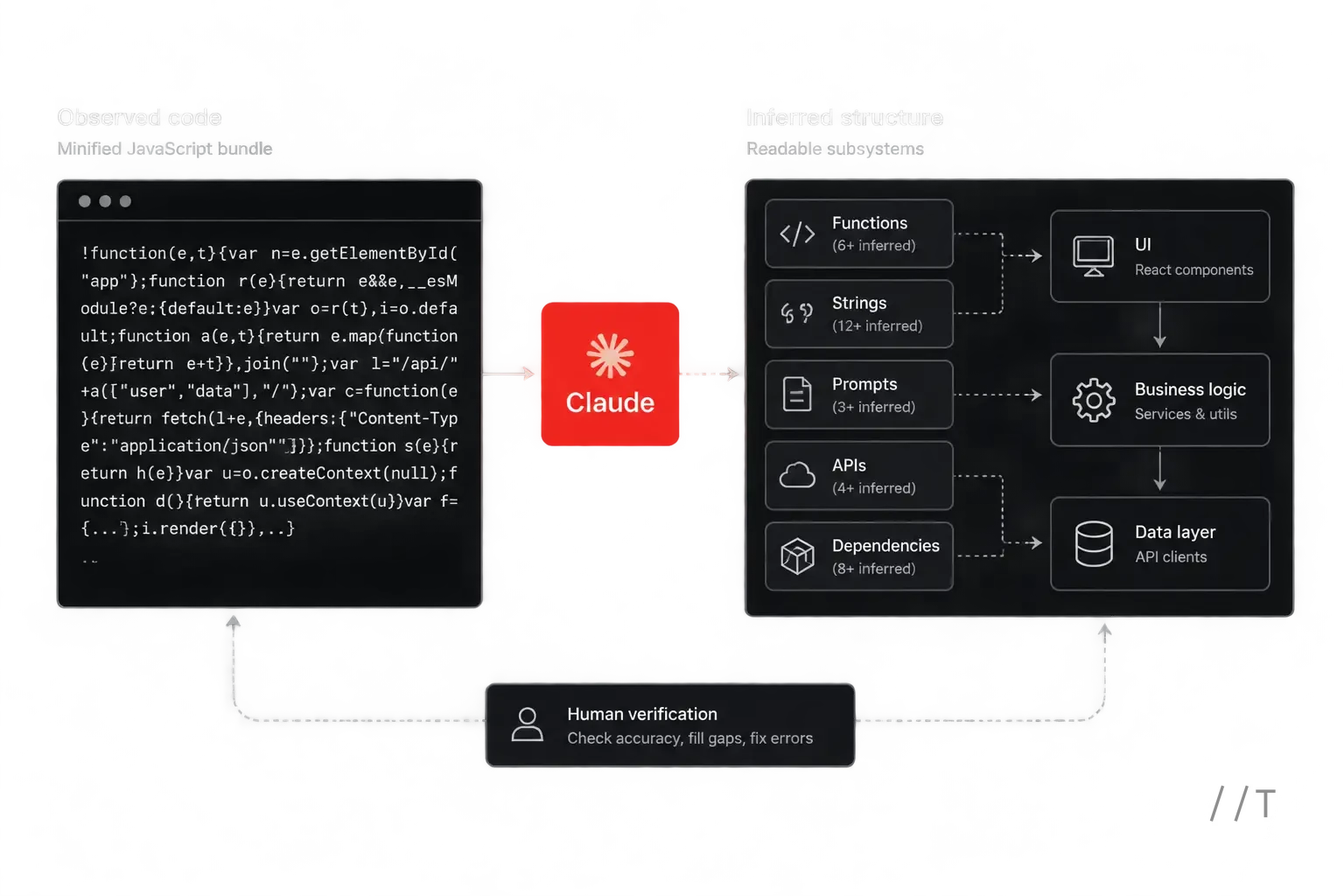
Claude is strongest at static comprehension: turning visible implementation evidence into a usable model of the system. Give it a minified JavaScript bundle and it can often deobfuscate control flow, extract strings, endpoints, prompts, environment variables, and error messages, then propose meaningful names for anonymous functions. It can group those functions into subsystems, summarize the architecture, trace tool and API flows, and translate the result into readable JavaScript or TypeScript.
That works because the task is mostly structure-to-structure conversion. The bundle already contains patterns, literals, call relationships, and protocol details. Claude organizes and labels that evidence; it is not required to invent an unknown contract. Projects analyzing Claude Code demonstrated this on bundles containing large numbers of strings and clues about prompts, telemetry, authentication, updates, and tool execution. Runtime traces add another useful layer: request and response logs can show how an agent assembles prompts, invokes tools, and handles common results.
Behavioral discovery is different. A plausible function name or architecture diagram is a hypothesis, not proof that the implementation behaves correctly. Claude may infer intent from static clues, but it cannot recover undocumented edge cases that never appear in the inspected code path or captured interactions. Treat its output as an annotated map of observed evidence, suitable for investigation and scaffolding—not as a verified specification.
Can Claude infer software behavior without source code? Only from observable evidence.
Claude can infer a useful behavioral contract without source code, but only from evidence it can inspect and reproduce. Static clues—function names, embedded strings, dependencies, endpoints, and control flow—suggest what a program may do. They do not establish what it does under real conditions.
Runtime evidence is stronger. API and filesystem traces show requests, ordering, payloads, and responses. File-format specifications define valid structures. Controlled inputs expose transformations; outputs and errors reveal accepted boundaries. Repeating the same operation while changing one variable can expose state transitions, persistence, and retry behavior.
The Claude Code reverse-engineering work demonstrates this distinction. Researchers instrumented the installed JavaScript and captured its interactions with model APIs across task scenarios. Those logs exposed practical contracts: how prompts were assembled, which tools were selected, and how responses were routed. Claude could then summarize those flows and help build a structurally similar implementation.
That evidence still has limits. A trace usually covers the path exercised, not hidden branches. It may miss timing-dependent races, permission failures, malformed files, interrupted writes, rate limits, recovery after crashes, and behavior that changes with platform or configuration. Even an interaction log showing a successful request says little about what happens when the network drops halfway through it.
Treat every inferred rule as a hypothesis until a controlled test confirms it. Claude can organize observations quickly; it cannot observe a behavior that your instrumentation, fixtures, or test cases never expose.
Claude Code exposed a bounded analysis problem; Adobe presents an open-ended product problem
Claude performed better on Claude Code because the target exposed unusually rich evidence. Its minified JavaScript bundle still contained function bodies, strings, prompts, endpoints, error messages, environment variables, and recognizable control flow. Analysts could parse and format the bundle, then ask Claude to rename symbols, group routines, trace API calls, and describe the architecture. Runtime instrumentation added request and response traces. The model was organizing visible facts, not guessing an entire product into existence.
That distinction matters. Understanding a system is easier than reproducing its complete user contract.
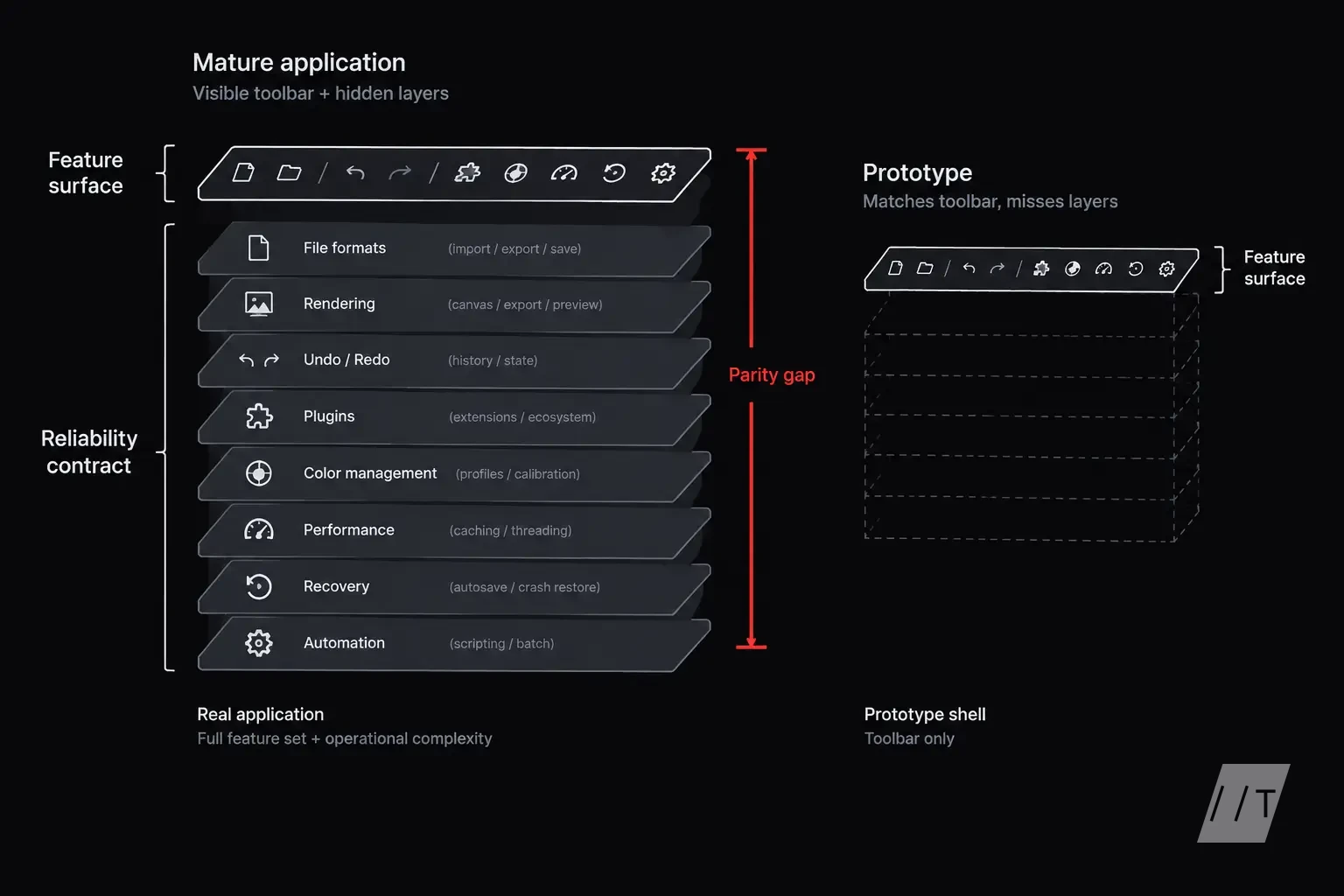
A mature creative suite has a much larger and less visible contract. It includes documented and undocumented file compatibility, color management, camera and lens profiles, plugin behavior, device workflows, rendering quality, latency, memory use, persistence, undo/redo semantics, autosave, crash recovery, permissions, and failure handling. Many of those behaviors appear only with particular hardware, large documents, malformed files, interrupted operations, or long sessions. A screenshot and a feature list expose almost none of them.
Claude Code was therefore a tractable reverse-engineering exercise: substantial textual evidence, a defined runtime, and observable API interactions. An Adobe replacement is a product-completeness exercise with accumulated edge cases. Claude can scaffold visible paths quickly, but each unobserved path becomes an inference—and an inference is not a compatibility guarantee. That is why matching menus and basic workflows can coexist with failures in transforms, exports, plugins, or repeatability.
What went wrong with the ArtCraft Adobe clones?
ArtCraft demonstrated that Claude can help produce credible open-source look-alikes quickly. It did not demonstrate Adobe-level compatibility. The projects were presented as clean-room reimplementations: new code based on public specifications and observed behavior, not Adobe’s source code. Several applications were still early alpha, and hands-on reports described glitches, incomplete features, and inconsistent interactions.
That gap appears when a workflow leaves the demo path. A familiar toolbar can hide failures in transform operations, large documents, import and export fidelity, camera and lens profiles, plugin ecosystems, and repeatable state changes. One tester reported that pressing Escape during Free Transform did nothing, then unexpectedly undid the transform; later attempts worked without a clear reason. Another report found that LightCraft lacked native camera-matched color and lens profiles. These are not cosmetic defects. They change whether a professional can trust the result.
The same problem applies to file compatibility. PhotoCraft reportedly opened layered PSD and PSB files and the project reported 134 of 135 test PSDs round-tripping byte for byte, but a subset of successful fixtures does not establish compatibility across every document, filter, color setting, or automation workflow. A feature count also says little about behavior under failure, memory pressure, or repeated edits.
ArtCraft’s developers produced real software, and the project may become useful for occasional editing. But clean-room development only describes how the implementation was made; it does not guarantee parity with Adobe’s accumulated undocumented behavior. Claude accelerated construction. It did not supply the missing reliability contract.
Narrow targets can make Claude-assisted rebuilding worthwhile
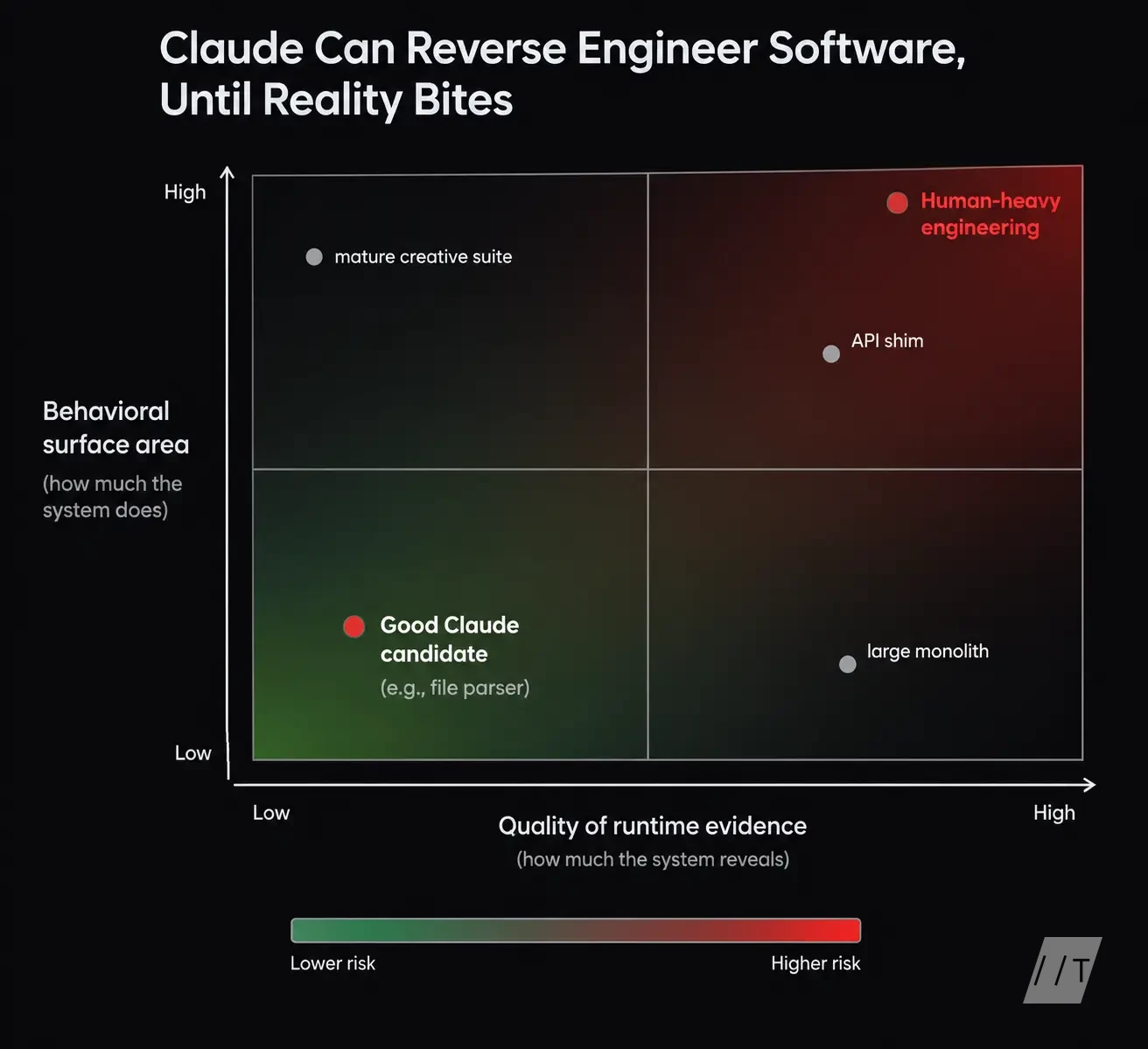
The strongest case against this thesis is that small, observable targets can work—and sometimes work surprisingly well. Claude-assisted rebuilding is a sensible choice for a documented file format, a compatibility shim, a browser utility, or a component with a narrow API contract. The model can turn specifications, traces, and example inputs into a useful implementation without having to recreate an entire product’s undocumented history.
PhotoCraft shows the practical upside. Its early-alpha editor supports layers, masks, adjustment layers, dozens of filters, and real PSD/PSB files; the project reports 134 of 135 test PSDs round-tripping byte for byte. That is meaningful progress for an occasional editor, especially when the alternative is paying for a large suite to make a few edits twice a year. Familiar workflows can emerge quickly when the file format and expected operations are visible enough to test.
That success does not establish Adobe parity. The thesis stops holding when the target’s value depends on broad compatibility, polished interaction, predictable performance, operational continuity, and trustworthy edge-case behavior. A mostly correct PSD round-trip is a useful subset. It does not prove reliable behavior across plugins, color profiles, huge documents, automation, recovery, or accumulated workflows. Claude is a strong accelerator for the bounded subset; the mature application remains an engineering program.
How should engineers validate Claude’s reverse-engineering output?
Treat every claim as a testable contract, not an explanation that sounds plausible. A reusable validation checklist should require engineers to:
- Tie each claimed behavior to observed inputs, outputs, and environmental conditions.
- Build golden fixtures from real files, including representative documents and known-corrupt examples.
- Compare state transitions, error types, side effects, and repeat runs—not just final screenshots or output files.
- Test destructive operations, empty inputs, malformed data, maximum sizes, cancellation, retries, and permission failures.
- Instrument API calls, filesystem access, subprocesses, timing, and resource usage so hidden dependencies become visible.
- Run differential tests against the original implementation, capturing both matching behavior and meaningful divergence.
- Have a human review security-sensitive code, licensing boundaries, and inferences that are not directly supported by observation.
Golden files alone are insufficient. A parser may produce the right output while corrupting metadata; an editor may render correctly while breaking undo history or saving unrecoverable state. Record latency and memory on representative workloads, then repeat tests across clean processes and multiple runs to expose nondeterminism.
The decision rule is strict: do not promote a component from prototype to production until its critical behaviors pass repeatable tests on representative workloads. “Critical” means the behaviors users, integrations, or recovery procedures depend on—not merely the features visible in a demo. If the original cannot be exercised reliably, label the implementation as an inference and keep that uncertainty in the design record rather than presenting it as compatibility.
When is Claude-assisted reverse engineering not worth using?
Stop when the target is poorly observable, the cost of wrong behavior is high, or compatibility spans undocumented workflows you cannot test. Strict latency or memory budgets, regulated or safety-sensitive deployment, missing real-world fixtures, and an existing stable alternative are also hard-stop signals. A personal editor used twice a year can tolerate glitches; a client-critical production system cannot. The apparent speed advantage often disappears once engineers add differential tests, human review, integration work, maintenance, and operational safeguards. Do not put an inferred implementation into production merely because its visible feature list matches. If critical behaviors cannot be measured repeatedly on representative workloads, Claude-assisted reverse engineering is not the economical path.
Use Claude as an evidence multiplier, not a parity oracle
Use Claude to deobfuscate code, summarize architecture, trace API interactions, scaffold components, and generate tests. Keep the original implementation running while you validate; do not replace a working tool because a prototype matches its screens or feature list.
Test real files and workflows, including malformed inputs, destructive actions, performance limits, repeat runs, and recovery after failure. Compare outputs and state transitions against the original, then have humans review security, licensing, and every ambiguous inference. Keep stable tools for deadline-critical work.
Claude is a strong accelerator for narrow, observable targets. ArtCraft’s early-alpha gap shows the limit: replacing a mature application is an engineering and verification program, not a prompting exercise.