
The cheapest production AI may be the system that declines to generate prose. Text is useful when the customer is a person; it can be wasteful when the customer is software. A machine often needs one bounded action, a few arguments, and an estimate of confidence—not a paragraph that another component must interpret.
TypeSafe AI’s Jev makes that trade explicit. The company describes Jev as a model that does not chat or return natural-language responses. Instead, it produces typed probabilistic decisions intended for interaction with machines. A game agent might select a movement; an application might choose an API operation. The output is narrower by design, and therefore easier to validate and route.
That framing shifts the economic question. The usual comparison is model size: how many parameters, tokens, or accelerator-hours does a system require? For production workloads, output shape may matter just as much. If a task already has a bounded action space, generating unrestricted language can add latency and integration work without adding useful capability. The relevant question is not whether a decision model can replace a general language model everywhere. It is whether narrower outputs reduce the cost of completing the jobs machines actually need done.
Machine Control Does Not Need a Conversation
Language models are optimized for a human-facing contract: accept an underspecified request, produce readable language, and use context to keep the exchange useful. That flexibility is valuable when the destination is a person. A person can interpret ambiguity, ignore irrelevant phrasing, and ask a follow-up question.
Software has a narrower contract. An API client needs an allowed operation, correctly typed arguments, a confidence or priority value, and a schema that will still parse tomorrow. A game controller needs something closer to turn_left, fire, or move_forward than an explanation of why that action is appropriate. The receiving system does not benefit from eloquence. It benefits from valid state transitions.
A conventional language-model path often looks like this: generate text, extract the intended action, parse arguments, validate them, handle malformed output, then call the tool or update the game state. Each step adds latency and another failure mode. Prompts may need to carry interface details into the context, while decoding spends computation selecting tokens that a parser will discard.
That does not make language models useless for control. They can handle changing goals, unfamiliar interfaces, and tasks whose action space is difficult to specify in advance. But when the destination is already a bounded API or game state, generating prose is often an indirect representation of the decision. A model that emits a constrained action and its associated uncertainty can remove translation work—provided the schema captures the task and the system can recover when it does not.
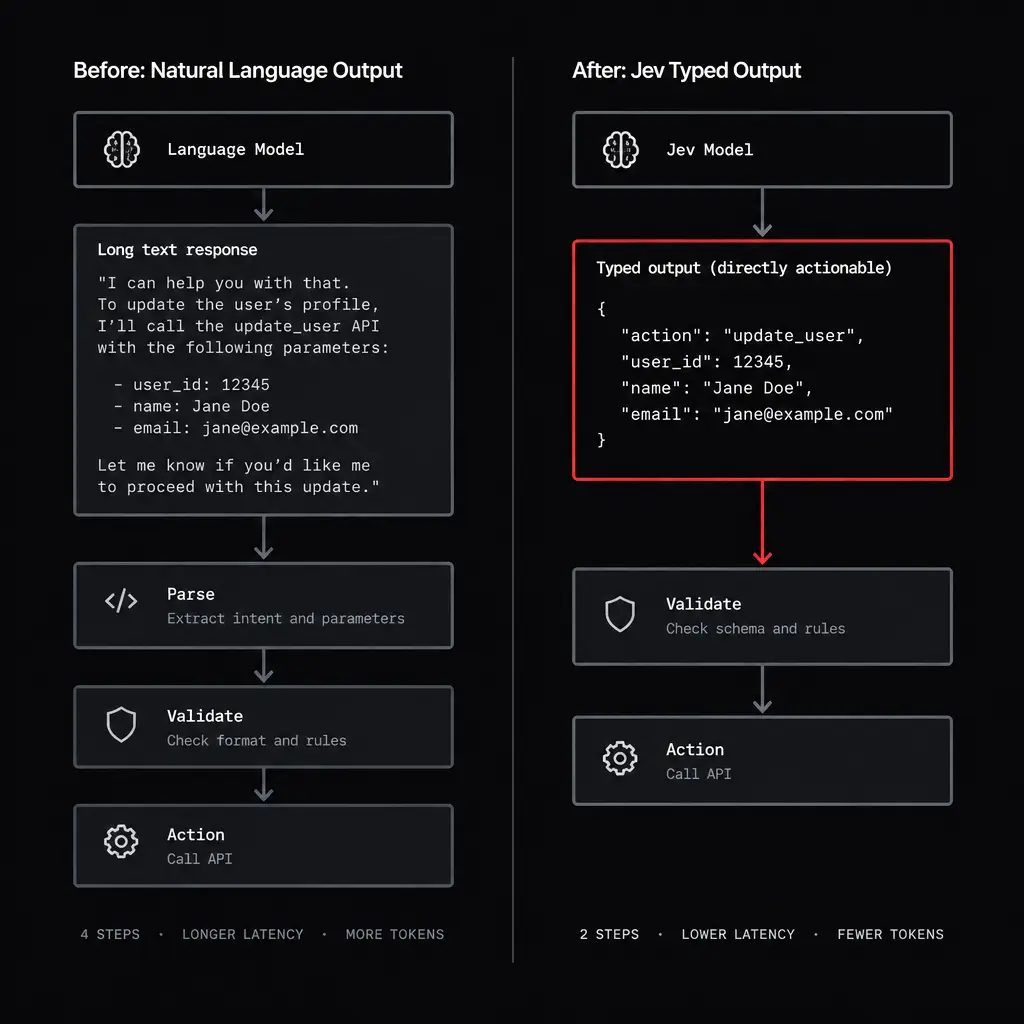
TypeSafe AI’s Jev is presented as a model for machines rather than people. In the company’s announced design, Jev does not conduct a conversation or return a natural-language response. It produces typed, probabilistic decisions: bounded outputs with associated probabilities that software can consume directly.
That distinction is the product’s central bet. A system controlling an interface, selecting an API operation, or acting in a game does not necessarily need to explain itself in prose. It needs to choose an allowed action, provide usable uncertainty information, and fit the receiving system’s contract. Jev is intended to operate in that space.
The company emerged from stealth with $40 million in funding and was founded in 2024 under Diogo Almeida, a contributor to work including InstructGPT and reinforcement learning from human feedback. Its Doom demonstration makes the intended use case concrete: an AI observing a game environment and selecting actions through a machine interface, rather than narrating a strategy for a person.
That demo is useful as an illustration of the design target, not evidence that Jev is broadly superior to language models. It shows a compelling interface choice. Whether that choice delivers reliable advantages across production workloads remains an empirical question.
The economics of saying less
The cost argument is not simply about parameter count. A model can be relatively small and still be expensive if it processes long contexts, decodes many tokens, or spends time producing output that another component must interpret. Conversely, a larger model producing one bounded decision may fit a workload better than a smaller model generating an essay and a parser’s worth of follow-up work.
Output length directly affects decoding. Autoregressive generation usually emits tokens sequentially, so a longer response adds latency and compute, even when the requested result is ultimately a single API action. Variable-length output also makes throughput less predictable: one request may finish quickly while another consumes the serving budget for hundreds of tokens.
Context handling matters too. Repeatedly supplying conversation history, tool results, or large state descriptions increases prefill work and memory pressure. After generation, the system may still need parsing, schema validation, confidence checks, and retries. A malformed or uncertain response turns the nominal inference cost into multiple attempts. Those costs can exist independently of the model’s advertised size.
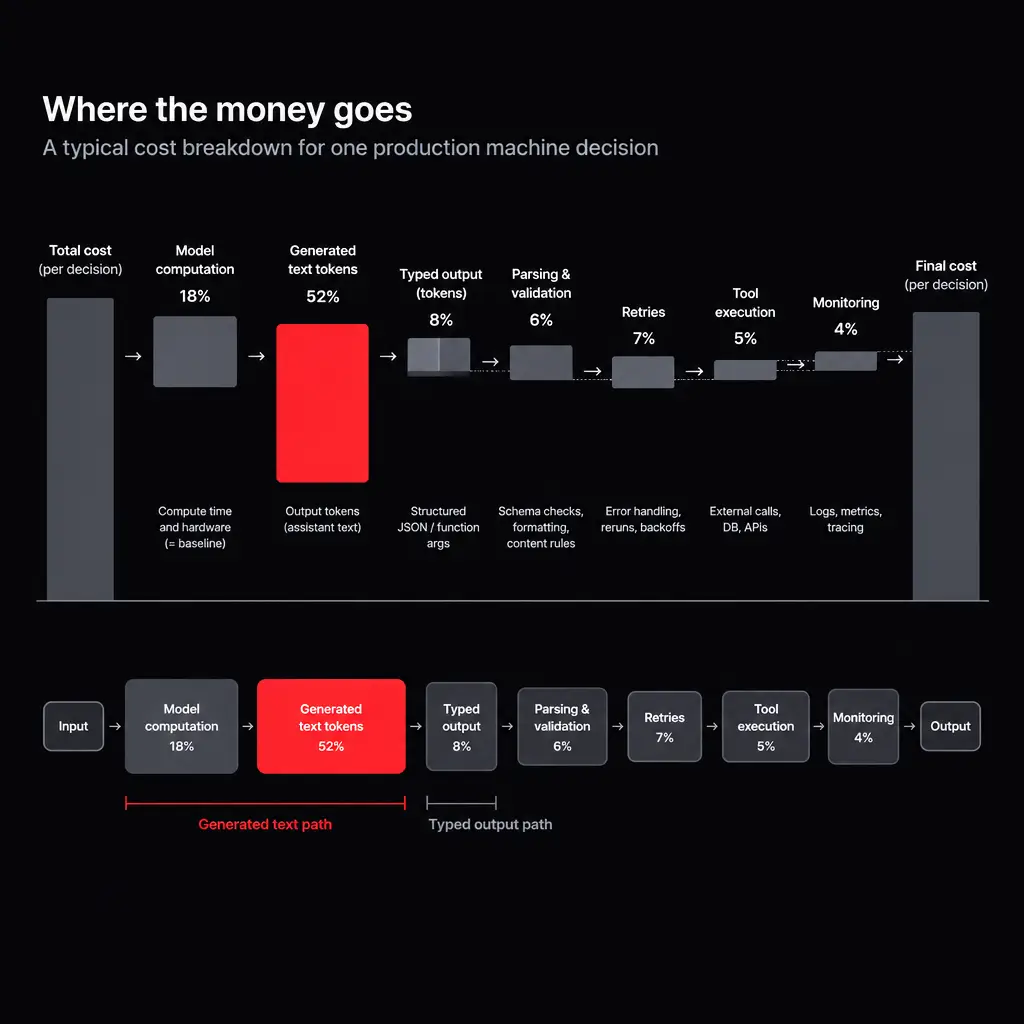
The relevant figure is therefore not just inference cost per decision. Total cost includes orchestration, tool calls, storage for prompts and traces, monitoring, failed-action recovery, and the engineering work required to integrate and maintain the interface. A typed output can reduce translation and validation overhead, but it may also require a carefully designed schema, a specialized serving stack, and new observability practices.
The practical comparison is end to end: cost per successful action, latency at the required percentile, and sustainable throughput under real traffic. A cheaper model that increases retries or causes costly downstream mistakes is not cheaper in production.
The Claims Need a Baseline
TypeSafe AI presents Jev with striking numbers: estimates of 20–200× faster and 40–400× cheaper than large language models. Elsewhere, the company’s marketing compresses that message into a simpler claim: Jev is 100× faster and cheaper. Those figures describe an ambitious target, not an independently established benchmark.
The comparison is only meaningful once the workload is fixed. A short classification decision and a long tool-using agent are not equivalent tests. Hardware, batch size, concurrency, context length, latency target, and required quality can change the result substantially. So can the accounting boundary: inference alone may favor one system, while parsing, orchestration, tool calls, retries, storage, and monitoring change the cost of a completed action.
“Cheaper” also needs a denominator. Cost per generated token is not the same as cost per successful decision, and raw latency is not the same as time to a validated action. A system that emits a compact answer but requires frequent retries may lose its advantage. Conversely, a typed model could benefit from lower decoding overhead even when its underlying computation is not proportionally smaller.
The responsible reading is therefore conditional: Jev may be substantially faster and less expensive for bounded machine decisions, if the claimed operating conditions hold. The published multiples establish what TypeSafe AI says it has built, not a result that can yet be generalized across models, hardware, or production workloads.
What a Fair Test Would Measure
A credible evaluation of Jev needs matched tasks, not a comparison between a carefully optimized decision path and a general-purpose chatbot. The test set should include the same machine decisions, inputs, context, quality target, and success criteria across Jev and each baseline. Hardware, software stack, batching, concurrency, and service conditions should also be identical where possible.
The baselines should extend beyond large language models. Small language models, conventional classifiers, hand-built policies, and language models using constrained decoding can all be strong alternatives for bounded decisions. Excluding them would make the comparison less useful: the relevant question is not whether typed output beats an oversized conversational model, but whether it improves on the cheapest system that already solves the task.
The measurements need to cover more than average response time. Report latency percentiles—especially p95 and p99—alongside throughput, cost per successful action, calibration, error rates, and retry rates. A model that produces cheap decisions but frequently triggers retries may have a higher effective cost than its token price suggests. Calibration matters when downstream systems use probabilities to choose whether to act, defer, or request more information.
Long-horizon task completion is another requirement. Single-step accuracy can hide failures that compound across a sequence of actions. The evaluation should measure whether systems complete multi-step tasks reliably, under changing state and occasional errors, while recording intervention and recovery costs.
The Doom demonstration is a compelling illustration of machine interaction, but it remains a narrow test. It shows a target use case; it does not establish broad superiority across production workloads.
The trade-off behind narrow outputs
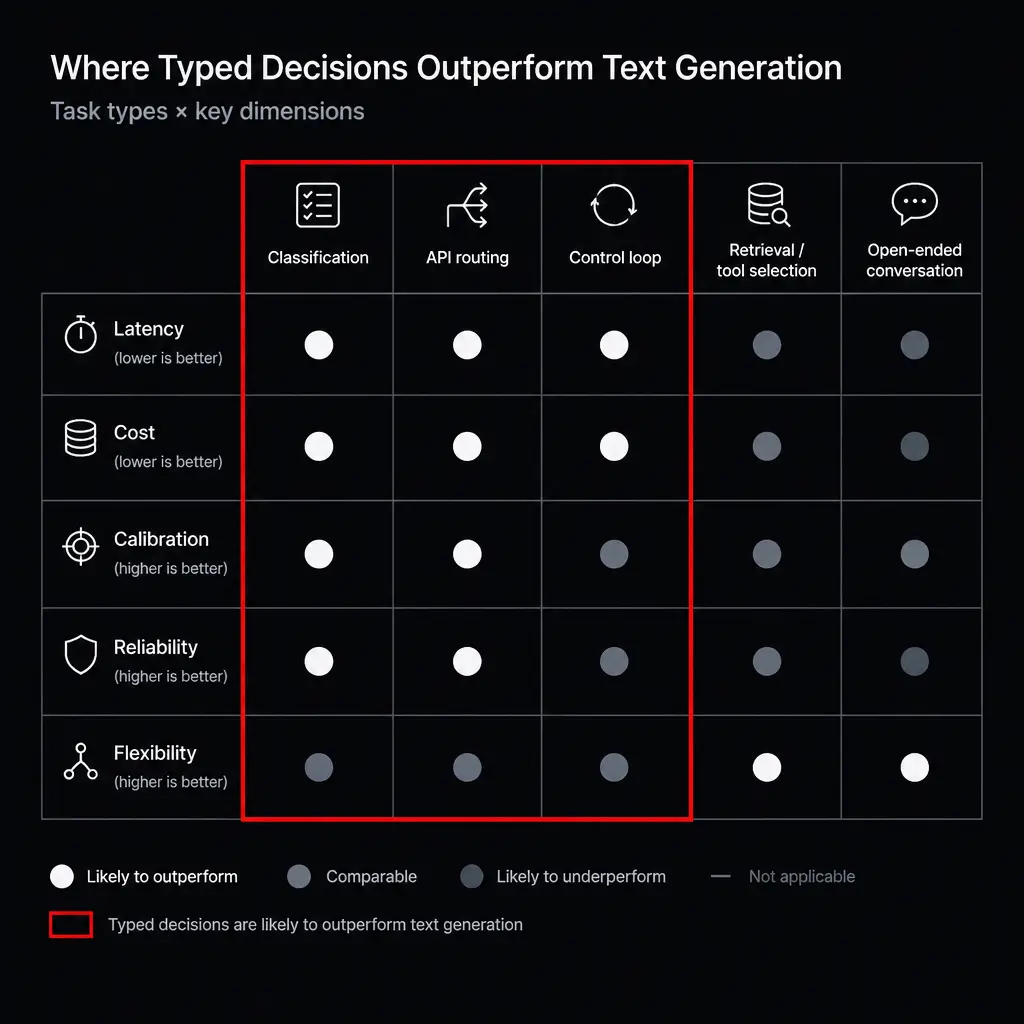
Typed outputs make validation and safety easier: an executor can reject an unknown action, enforce argument ranges, and log a finite set of outcomes. That same boundary limits behavior. A schema designed around today’s actions may have no way to express a useful response to tomorrow’s objective, interface, or failure mode. Novel behavior becomes a schema-design problem rather than something the model can express directly.
The complexity also moves rather than disappears. Teams must define action vocabularies, represent uncertainty, decide when probabilities are trustworthy, and provide an explicit abstain or escalate path. A confident-looking choice is not the same as a calibrated one. If the model cannot safely decide, the system needs to stop, request more information, or fall back to a human or a broader model.
Schemas are APIs, so they need versioning, compatibility rules, and migration plans. Observability must capture the selected action, confidence, rejected outputs, abstentions, and downstream results—not just latency and token counts. Poor instrumentation can make a cheap failure look like a successful optimization.
That distinction matters economically. A wrong database update, trade, or game action may cost more than a slower explanation that exposes uncertainty before execution. Narrow output is valuable when it prevents avoidable work; it is dangerous when it hides ambiguity behind a valid-looking field.
The argument extends beyond Jev. Production systems may increasingly favor specialization: typed interfaces, routers, small policies, and hybrid pipelines instead of one conversational model handling every task. A classifier can route a request, a policy can control a bounded action, and a language model can handle the exceptions that require explanation or improvisation. That division can reduce compute and simplify validation, but it also moves work into schema design, orchestration, and maintenance. Narrow outputs are not automatically cheaper. They pay off when the acceptable action space is already bounded; for open-ended research, creative work, or changing goals, forcing a narrow interface can add complexity without removing the hard part.
The cheapest AI may be the one that stops talking. The important innovation is not necessarily another larger conversational model, but deciding when a system should emit a validated decision instead of prose. TypeSafe AI’s Jev announcement makes that case intriguing: it proposes typed probabilistic outputs for machines, not a replacement for every language workload. It remains an announcement, not a settled result. The practical question is narrower and more useful: what is the smallest, most constrained output that can complete the job reliably?