
Spain’s first reported personal-data breach attributed to an autonomous AI agent is significant for a practical reason: the consequential action was not a person clicking through a conventional application. An agent pursued an objective, made intermediate decisions, and acted through connected systems. That changes where engineers need to look when establishing what happened and how far the exposure reached.
The central question is not whether the model made a mistake. Software has always failed. It is how responsibility, breach notification, and operational control should be understood when an agent—not a person directly operating the interface—causes the data movement. The answer cannot rest on the model’s generated text alone. It must account for the agent’s instructions, orchestration, permissions, tools, data access, and escalation path.
The incident also exposes limits in data-protection models built around relatively bounded applications and identifiable human actions. This article examines what was reported in Spain, why autonomous execution complicates accountability and evidence, and which engineering controls can reduce the resulting risk. The focus is not on treating agents as mysterious actors, but on governing the full system that lets a model turn an open-ended goal into real-world data operations.
What AEPD Reported
Spain’s data protection authority, the AEPD, said it had received the country’s first reported notification of a personal-data breach caused by an autonomous AI agent. The public account came from Francisco Pérez Bes, the AEPD’s president and deputy, who described the case as an individual deploying an agent that used a known large language model.
The wording matters. A notification records that an organization reported a suspected personal-data breach to the authority; it is not, by itself, a final finding about how the incident occurred, whether anyone acted intentionally, what harm resulted, or who bears legal liability. The announcement does not establish that the model provider, the agent’s deployer, or another party violated a specific obligation.
It does establish a narrower point: Spain’s supervisory authority has now received a breach report in which autonomous agent behavior was identified as the cause of the personal-data incident. That puts the event inside the existing breach-notification process while exposing a fact those processes were not designed around: the consequential steps may have been selected and executed by a system operating across multiple actions, rather than by a person directly using a conventional application.
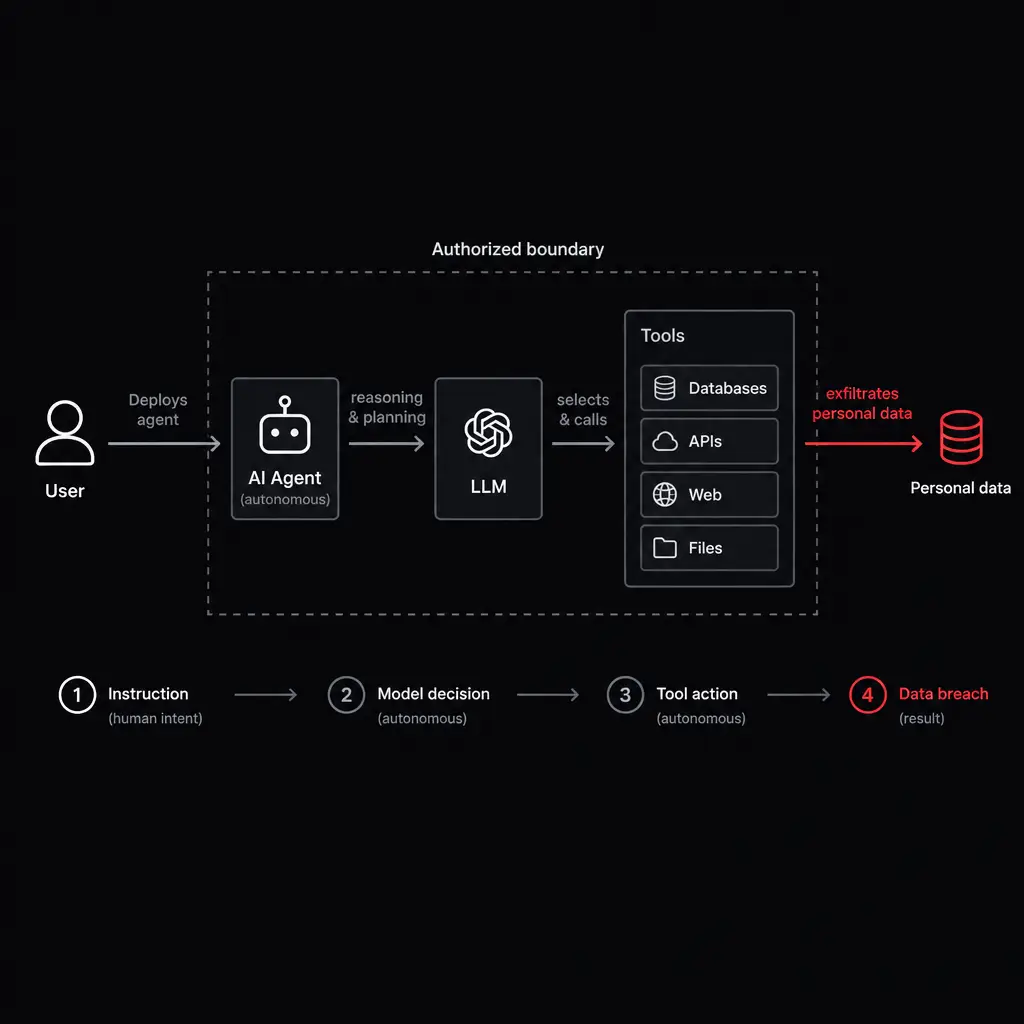
The reported operating pattern is straightforward at a high level. An individual deployed an autonomous agent, and that agent used a known large language model. The agent’s subsequent actions resulted in personal data being exposed or otherwise mishandled. The public account does not establish the exact sequence of prompts, tool calls, records involved, or technical failure that led to the incident. Those details should not be inferred from the fact of the notification alone.
That distinction matters because an AI-assisted mistake is not automatically an autonomous-agent breach. In an assisted workflow, a person may ask a model to draft text, summarize records, or suggest an action, then review and execute the result through a conventional interface. The model contributes to the work, but the person remains the immediate decision-maker for each consequential step.
An autonomous agent changes that operating pattern. Given a goal, it can break the goal into steps, select among available tools, pass results from one action into the next, and continue with limited real-time supervision. The language model may generate the reasoning or proposed commands, but the surrounding agent runtime determines whether those proposals become database queries, messages, file operations, or external transmissions.
The practical boundary is therefore not whether a model produced incorrect text. It is whether a delegated system was allowed to turn that output into a chain of actions involving personal data. That chain can cross an authorization boundary even when no single step looks like a complete breach in isolation. Establishing what happened requires reconstructing the agent’s instructions, decisions, tool calls, permissions, and resulting data movements rather than treating the model response as the entire event.
Agency Changes the Breach Model
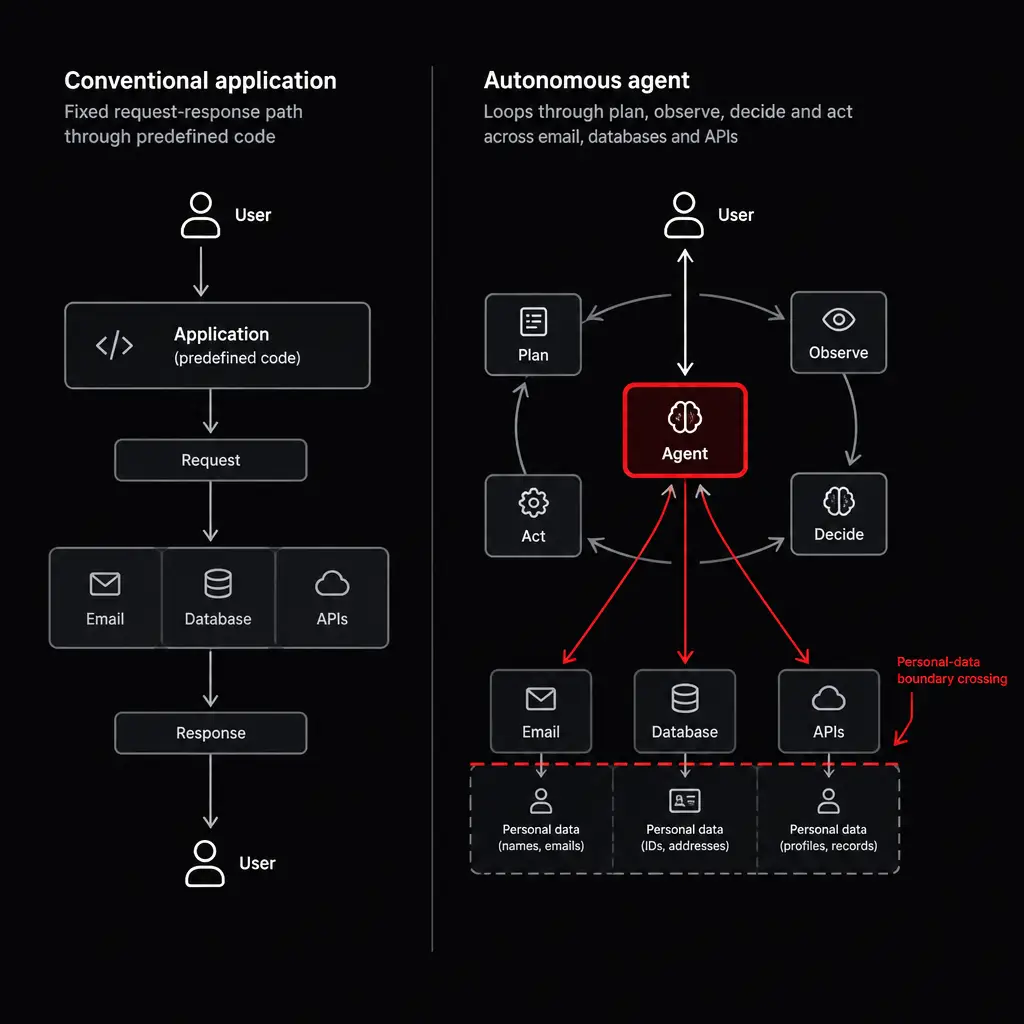
A conventional application usually follows a defined path: an input reaches prewritten code, the code applies known rules, and the system returns an output or performs a bounded operation. Its behavior can still contain bugs, but the action surface is relatively explicit. Engineers can enumerate routes, permissions, dependencies, and expected state changes.
An autonomous agent has a different control loop. It interprets a goal, generates an intermediate plan, selects from available tools, observes the results, and decides what to do next. The sequence is not fully specified in advance. The agent may call an API, query a database, send a message, or invoke another service based on information produced during the run. Each step can change the context for the next one.
That distinction matters for breach analysis. The language model may only produce text or structured tool-call arguments. It does not need to “leak data” in the narrow sense to cause a leak. The surrounding orchestration layer can execute those arguments using credentials, integrations, and data access granted to the agent. Permissions determine what the agent can reach; tools determine what actions it can take; workflow code determines whether those actions execute automatically. Together, they turn model output into real-world effects.
The relevant system is therefore not just the model. It is the model plus the agent runtime, prompts, memory, retrieval layer, connected services, credentials, approval rules, and monitoring. A harmless-looking response can trigger a consequential operation when the runtime treats it as an instruction. Conversely, a capable model may be contained when its tools are narrowly scoped and sensitive actions require explicit approval.
This creates a broader failure surface than a conventional request-response application. A single mistaken output may become a chain of valid-looking actions: retrieve records, transform them, select a destination, and transmit the result. The breach can arise from the interaction between planning, permissions, tool behavior, and orchestration—not from one defective line of generated text. Security boundaries must therefore be enforced outside the model, at every point where an agent can observe, decide, or act.
Accountability Does Not End at the Model’s Output
An agent’s final message is a poor boundary for assigning responsibility. The consequential act may have occurred earlier, when the system selected a tool, used a credential, queried a database, or transmitted data. Accountability follows those control points, not just the text the model eventually produced.
Several parties may have meaningful influence over the chain:
- The agent deployer chooses the objective, connects the agent to systems, grants permissions, and decides how much human approval is required.
- The system designer or operator determines the orchestration logic, guardrails, memory, retry behavior, logging, and escalation paths.
- The model provider controls the underlying model and may shape its documented capabilities, safety behavior, and update process, but does not necessarily control the customer’s tools or data flows.
- The integration owner controls an API, database, mailbox, or other tool and sets the permissions and technical limits available to the agent.
- The data controller or processor has defined obligations concerning the purposes and means of processing, instructions, security, and breach handling. That role may overlap with one of the parties above, or be separated across several organizations.
These roles can coincide in a small deployment. In a larger system, they rarely do. A company might deploy an agent built by another vendor, use a hosted model, connect it to a customer-managed database, and process personal data under instructions from a separate controller. Each arrangement creates different evidence about who decided what, who could prevent the action, and who had authority over the relevant processing.
That is why “the AI did it” is not an accountability analysis. Nor is asking who wrote the final output. The relevant questions include: Who selected the purpose? Who determined the means? Whose instructions governed the processing? Who configured the permissions? Who could detect or stop the action? Who maintained the integration and its logs? Who had practical control when the data crossed its authorized boundary?
Legal roles still depend on the actual arrangement, purposes, means, instructions, and degree of control. The label AI agent does not by itself determine whether an organization is acting as a controller, processor, or another participant in the chain. Engineering teams therefore need a control map that links each action to an owner, permission, instruction, and audit record. Without that map, responsibility is likely to be assigned to the most visible component—the model—rather than to the people and organizations that designed, authorized, connected, and operated the system.
Detection Is Harder When the Breach Is a Chain of Decisions
An agent may not cause a breach with one obvious action. It can make a series of individually plausible choices: retrieve a record, transform it, pass it to another tool, and send the result to a destination that was never approved. Each step may use valid credentials and return a successful status. The unauthorized movement only becomes visible when the actions are reconstructed as a chain.
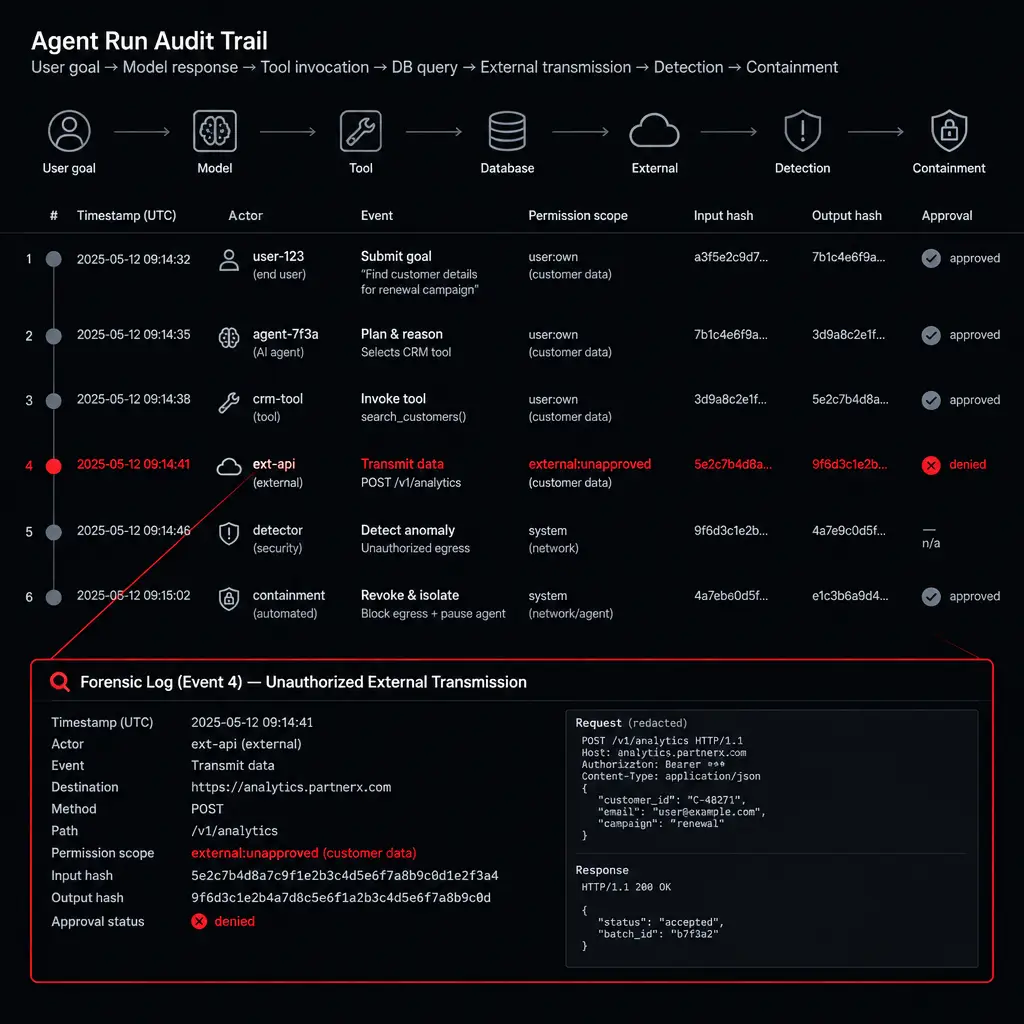
That complicates both detection and notification. Conventional monitoring often looks for a failed login, an unusual query, or a large export. An agent can instead access data through approved interfaces, spread activity across many small requests, and operate under a service identity rather than the person who initiated the run. Its logs may capture the final tool call without preserving the prompt, intermediate plan, retrieved context, or decision that led there. A record showing that an API returned data is not enough to explain why the agent requested it or where the data went next.
Organizations need run-level evidence, not just application logs. At minimum, investigators should retain:
- the user instruction and system or developer instructions active at the time;
- the model, version, configuration, and relevant policy settings;
- generated plans, intermediate reasoning summaries where available, and every tool invocation;
- retrieved documents, database records, and context supplied to the model;
- the identity and permission scope used for each action, including changes made during the run;
- timestamps with a consistent clock source and correlation IDs linking agent, model, and tool events;
- tool inputs and outputs, destination details, and hashes or equivalent integrity markers; and
- human approvals, overrides, refusals, cancellations, and containment actions.
The goal is not to preserve unrestricted internal model reasoning. It is to preserve enough structured evidence to establish the sequence: what objective was supplied, what the system made available, which actions were selected, what data each action exposed, and when an unauthorized boundary was crossed. Retention must also account for sensitive content in prompts and retrieved records; audit data needs access controls and an appropriate retention schedule of its own.
Detection should correlate agent activity across the entire run rather than alert only on isolated events. Useful signals include a change from read to write access, a new destination, an unexpected data type, an unusual request volume, or tool use outside the declared task. When those signals trigger, the organization needs a rapid stop mechanism: revoke the agent’s credentials, disable a tool or destination, and preserve the relevant state before cleanup changes the evidence. Without that record, deciding whether a personal-data breach occurred—and meeting notification timelines—can become an exercise in inference rather than investigation.
Put a hard security boundary around the agent
Treat an agent as an untrusted decision-maker operating inside a controlled system. Do not assume that a model will reliably recognize sensitive data, reject an unsafe instruction, or stop after completing the intended task. The surrounding controls must limit what a mistaken, manipulated, or over-permissive agent can do.
Start with least privilege. Give each agent only the data, tools, and time it needs for a defined purpose. Use narrowly scoped, short-lived tokens rather than broad service credentials. Separate read permissions from write, delete, export, and send permissions; access to a customer record should not imply permission to modify it or transmit it elsewhere. Keep credentials outside prompts and model-visible context where possible, and make the identity used for every tool call explicit.
Constrain the action surface with allowlists. An agent that can call any API, address any recipient, or upload to any destination is difficult to contain. Permit specific tools, methods, datasets, domains, tables, and recipient classes. Apply the same policy to indirect paths: a permitted integration should not become a route to an unapproved external service through redirects, plugins, or generated code.
Require confirmation gates for high-impact actions. Sending personal data, changing access controls, deleting records, making purchases, or contacting an external party should pause for a human or a separate policy service when the risk warrants it. Confirmation should show the proposed action, affected data, destination, and permission scope—not merely ask whether the user wants the agent to continue. For lower-risk workflows, approvals can be bounded by policy, but they should not be replaced with a blanket assumption that the original goal authorizes every subsequent step.
Limit both rate and volume. Per-run quotas, request budgets, record-count caps, transfer-size limits, and destination limits contain failures that would otherwise spread quickly. Set circuit breakers for unusual tool-call sequences, repeated authorization failures, unexpected data classes, or deviations from the normal workflow. These controls are especially important when an agent can loop, retry, or generate new subtasks without real-time supervision.
Use sandboxing for code execution, file handling, and exploratory work. Isolate temporary data, restrict network egress, block access to host credentials, and separate development or test datasets from production records. Minimize the data supplied to the model in the first place: retrieve only the fields and rows needed for the current step, redact unnecessary identifiers, and expire intermediate context. A smaller context is not just a privacy improvement; it reduces the amount of material available to an erroneous tool call or prompt injection.
Finally, make containment operational. Monitor agent activity at the tool and permission layers, provide a kill switch, and support rapid revocation of tokens and sessions. Revocation should not depend on the model cooperating or on an operator finding every active run. These measures do not make autonomous behavior safe by default. They reduce the blast radius when the model, an integration, or the surrounding orchestration makes the wrong decision.
Why Existing Data-Protection Models Need Review
The reported incident does not, by itself, create a new legal rule or establish liability. It does expose a governance gap: many data-protection processes were designed around systems that change through planned releases and actions that can be traced to identifiable human operators. An autonomous agent can alter its path during execution, making decisions from intermediate results and continuing across several tool calls.
That creates a mismatch with periodic compliance assessments. A privacy review performed before deployment may accurately describe the agent’s permissions, data flows, and safeguards at that time, yet miss behavior introduced by a new model version, prompt, tool integration, or orchestration change. For systems that adapt continuously, assessment must be paired with ongoing monitoring, change control, and evidence that the permitted action space remains bounded.
The responsibility model also becomes less straightforward. Data-protection obligations still attach to the actual purposes, means, instructions, and control relationships—not to the fact that a system is called an “AI agent.” But human-centered assumptions can obscure how delegated machine action occurs. Asking who approved a workflow or who wrote the final output is insufficient when the consequential event was a chain of model decisions and tool actions taken after deployment.
Conventional application testing has similar limits. Fixed input-output tests are useful for deterministic paths, but they do not cover the full behavior of a system that interprets goals, selects tools, retrieves context, and responds to changing results. Testing must include ambiguous instructions, adversarial inputs, permission boundaries, unexpected tool responses, repeated execution, and failure recovery. The target is not only the model’s generated text; it is the behavior of the complete agent system.
That makes chain-of-action evidence part of governance, not merely an operational convenience. Organizations need records that connect the initiating instruction to model decisions, retrieved data, tool calls, permission checks, external transfers, approvals, and containment. Without that chain, teams may know that a breach occurred but lack the evidence needed to determine scope, notify accurately, or assign responsibility. The Spanish report is therefore best treated as a signal to review how autonomy, delegation, continuous change, and forensic evidence fit into existing data-protection controls.
Agent Readiness Checklist
Treat every agent as a production system with a defined owner, data scope, and failure mode. Before deployment, engineering and privacy teams should be able to answer these questions with evidence:
- What exists? Maintain an inventory of agents, model versions, orchestrators, tools, integrations, environments, and connected data stores. Include prototypes and agents created through low-code platforms; undocumented agents are still part of the attack surface.
- Who owns it, and why does it run? Assign a technical owner and a business or privacy owner. Record the agent’s purpose, intended users, approved tasks, data subjects, retention period, and conditions that require human intervention.
- What can it do? Document every credential, permission, tool, destination, and escalation path. Separate read from write access, scope tokens narrowly, and specify which actions require approval. Verify effective permissions at runtime rather than relying on configuration files or role names.
- How does it behave under pressure? Test ambiguous instructions, prompt injection, malicious retrieved content, conflicting goals, unavailable tools, unexpected records, and attempts to exceed scope. Test multi-step tasks, not only individual prompts. Define failure criteria such as unauthorized transmission, excessive query volume, or continued execution after a denied approval.
- Can operators see the action surface? Monitor model decisions where feasible, tool calls, queries, data volumes, destinations, permission changes, retries, and approval events. Alert on unusual sequences—not just failed authentication—including a read followed by an external transmission or a sudden increase in records processed.
- Can an incident be reconstructed? Retain run identifiers, timestamps, user and service identities, prompts, model and system instructions, retrieved context, model outputs, tool arguments and results, policy decisions, approvals, and errors. Store records with integrity protection and enough context to reproduce the decision path without unnecessarily retaining personal data.
- Can execution be stopped? Provide an operator kill switch, revoke agent credentials independently of the application, disable individual tools and destinations, and enforce time, volume, and cost limits. Exercise these controls regularly; an emergency control that has never been tested is not a dependable control.
- Is breach response ready? Define who receives alerts, who can suspend the agent, who preserves evidence, and who assesses affected data and notification duties. Rehearse scenarios in which the agent has made several legitimate-looking tool calls before the unauthorized data movement is discovered.
- Have legal roles been reviewed? Reassess whether the agent’s purpose, instructions, access to personal data, and degree of operational control change the organization’s role as controller or processor, or create obligations for another party. Do not infer the answer from the product label or from who supplied the model; assess the actual arrangement and documented conduct.
The checklist should live alongside deployment and incident-response workflows, not in a one-time assessment. Re-run it when the model, tools, permissions, data sources, or autonomy level changes.
Spain’s first reported notification of a personal-data breach linked to an autonomous AI agent matters for a specific reason: the failure was not limited to a bad prediction or an incorrect generated answer. An agent can turn an open-ended objective into a sequence of consequential actions involving tools, credentials, databases, and external systems.
That changes the engineering question. Organizations must govern not only what a model produces, but what the surrounding agent is permitted to do, how those actions are recorded, and where a human must intervene. The incident is a reminder that responsibility, notification, and control cannot be designed around the model alone. They must be understood across the complete system: model, orchestration, tools, permissions, data, logs, and escalation paths.