Alibaba’s release of Qwen3.8-Flash-Next is notable for two concrete reasons: the weights are available for a multimodal mixture-of-experts model, and Alibaba describes that model as an early preview of the architecture used in Qwen4. That gives practitioners something they can run and inspect now—not just a roadmap claim.
The distinction matters. Qwen3.8-Flash-Next is an available model and an experimental target for profiling, multimodal evaluation, and serving work. It is not, by itself, a complete Qwen4 announcement. The useful question today is what this released model reveals about sparse multimodal inference, and which engineering assumptions still need to be tested before drawing conclusions about Qwen4.
What the Release Actually Contains
Alibaba and the Qwen team say they are opening the weights of Qwen3.8-Flash-Next. That gives practitioners a concrete model artifact to obtain, load, and evaluate. It does not, by itself, amount to the release of a complete production serving stack.
Weights are only one part of deployment. A production system also depends on the model implementation, preprocessing and postprocessing paths, tokenizer and vision components, runtime support, kernel choices, parallelism strategy, monitoring, and operational safeguards. The available announcement establishes that the model weights are being opened; it does not establish an exhaustive technical disclosure of every component or a turnkey production configuration.
The distinction matters for evaluation. A checkpoint may be runnable while still requiring engineering work to reproduce the intended multimodal path, support sparse expert execution, and achieve predictable throughput and memory behavior. Results from one runtime or hardware configuration should therefore be treated as deployment measurements, not intrinsic guarantees supplied by the weight release.
The Qwen team also describes Qwen3.8-Flash-Next as a multimodal mixture-of-experts model and as an early preview of the architecture used in Qwen4. That is a forward-looking relationship, not a complete Qwen4 specification. It does not establish Qwen4’s final weights, interfaces, release status, performance, or production readiness. The precise claim is that this release offers an early architectural signal; it is not that Qwen3.8-Flash-Next is Qwen4 or that behavior observed here will carry over unchanged.
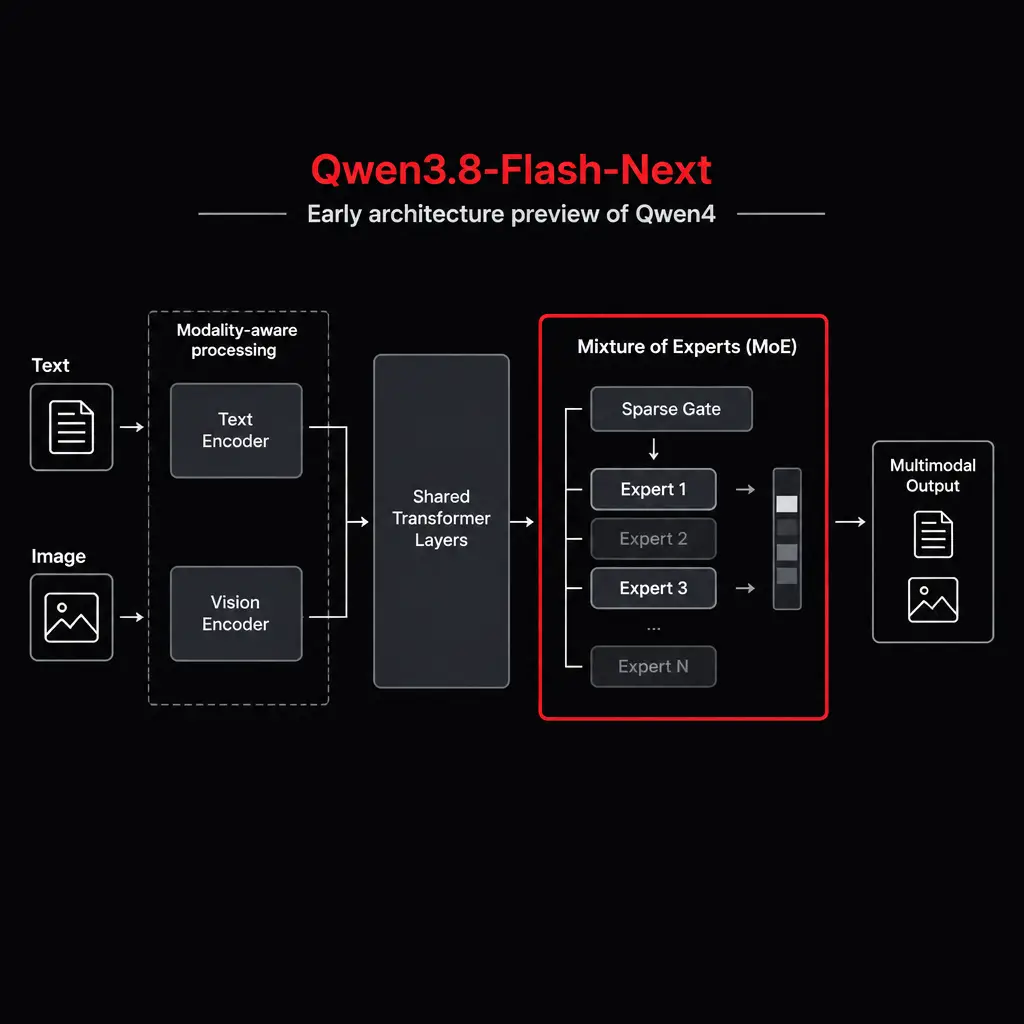
The engineering premise is straightforward: combine multimodal processing with sparse mixture-of-experts (MoE) routing. Text and visual inputs can be represented together, while a router selects only a subset of expert blocks for each token or intermediate representation. The model therefore keeps a larger pool of learned capacity without executing every expert on every step.
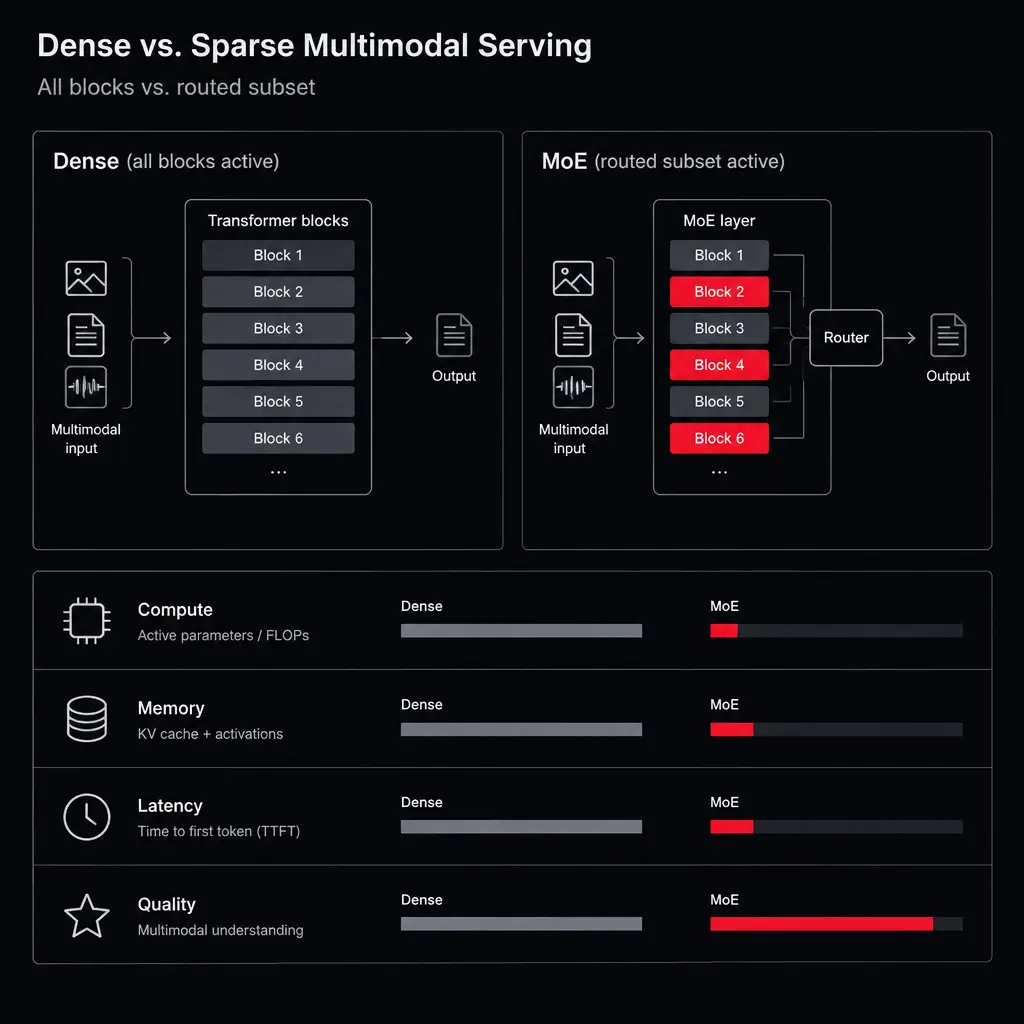
That separation between total parameters and active computation is the source of the cost-efficiency argument. It does not make the inactive experts free: their weights still have to be stored, placed, loaded, and managed. But, when routing is effective, each token can use less compute than a dense model with the same full parameter pool. The practical question is whether that reduction survives real serving conditions, including batching, communication, synchronization, and multimodal preprocessing.
For inference throughput, sparse activation changes the bottleneck profile. Expert computation may decrease, while dispatching tokens, gathering outputs, and moving data between devices become more important. Uneven routing can also leave some experts overloaded while others sit idle. A system that looks efficient at the model-graph level may therefore deliver weaker throughput if its router produces poor balance or if expert transfers dominate execution.
Memory planning is similarly different from planning for a dense model. The serving stack must account for the full expert pool, shared layers, modality-specific components, runtime activations, and any duplicated or sharded weights. Expert placement becomes a scheduling decision: keeping all experts resident improves availability but consumes memory, while loading or offloading experts reduces the resident footprint at the cost of movement and possible stalls. The right choice depends on hardware, concurrency, batching, and the workload’s routing pattern.
Routing also becomes part of runtime behavior rather than an internal implementation detail. Engineers need to inspect how consistently requests select experts, whether multimodal inputs produce different utilization patterns from text-only inputs, and whether skew worsens under distribution shifts. These observations affect capacity planning, load balancing, parallelism, and tail-latency control.
The tradeoff is additional serving complexity. A sparse multimodal model requires coordination across preprocessing, modality handling, routing, expert execution, and output generation. Quantization, batching, caching, and accelerator partitioning may interact with that path in ways that are not visible from parameter counts alone. Qwen3.8-Flash-Next makes this architecture concrete enough to measure, but its cost-efficiency must be established on representative deployments rather than assumed from sparse routing alone.
What the Open Preview Makes Testable
Opening the weights turns the architecture description into an artifact engineers can run. Start by loading the checkpoint in a controlled environment and reproducing basic inference before drawing conclusions from throughput or quality measurements. Record the model revision, runtime, accelerator, precision, preprocessing path, and decoding settings; otherwise, apparent differences may come from the stack rather than the model.
The multimodal path deserves separate inspection. Test text-only prompts, image-only inputs where supported, and requests that combine both. Check how images are accepted, normalized, represented, and aligned with text, then compare outputs for the same task across modalities. This can expose practical issues that a model card or high-level architecture description will not: preprocessing overhead, sensitivity to resolution or format, modality-specific failures, and changes in output quality when visual context is added.
A mixture-of-experts model also creates runtime behavior worth measuring. Where the framework exposes router or expert telemetry, log expert selections, token distributions, dropped or reassigned tokens, and routing changes across repeated runs. Useful questions include whether a small subset of experts dominates traffic, whether multimodal tokens select different experts from text tokens, and whether routing remains stable as prompts, images, batch sizes, or sequence lengths change. These measurements may not be available in every serving stack, so absence of telemetry should be recorded as an observability limitation rather than treated as evidence of stable routing.
Evaluate quality and cost together on representative workloads. Measure task success alongside latency, throughput, accelerator memory, preprocessing time, and serving overhead. A lower active-compute footprint is only valuable if it survives real batching and produces acceptable results. Include matched text-only and multimodal cases so that any cost increase from visual processing is visible rather than hidden inside a single aggregate number.
The resulting comparison should be operational, not anecdotal: fixed workloads, repeated runs, identical generation settings, and explicit failure categories. The preview is most useful when it reveals where sparse multimodal execution helps, where it adds complexity, and which parts of the inference path still cannot be observed or reproduced reliably.
A Practical Evaluation Plan
Start by pinning the environment before measuring anything. Record the checkpoint revision, model and processor versions, framework and kernel versions, CUDA or accelerator runtime, quantization settings, and serving configuration. Capture the exact GPU model, GPU count, host memory, storage, and interconnect. MoE routing and multimodal preprocessing can make results sensitive to these details, so an unlabeled benchmark is difficult to reproduce or compare.
Validate checkpoint loading as a separate step from performance testing. Confirm that the model loads without missing or unexpectedly converted weights, that the tokenizer and image processor match the checkpoint, and that deterministic smoke tests produce valid text and multimodal outputs. Keep preprocessing, generation parameters, precision, and stopping rules fixed while debugging; otherwise loader failures and quality differences become hard to distinguish.
Build a workload set with three classes:
- Text-only: prompts covering short answers, long-form generation, structured output, and the target context lengths.
- Image understanding: representative images and tasks such as description, visual question answering, document interpretation, and chart or table reading where relevant.
- Mixed multimodal: conversations that combine text and images, including multiple turns and varied image sizes if the application will use them.
Use a fixed request set for regression tests and a separate sampled set for broader behavior. Include difficult and failure-prone cases, not only examples that fit the model’s expected strengths.
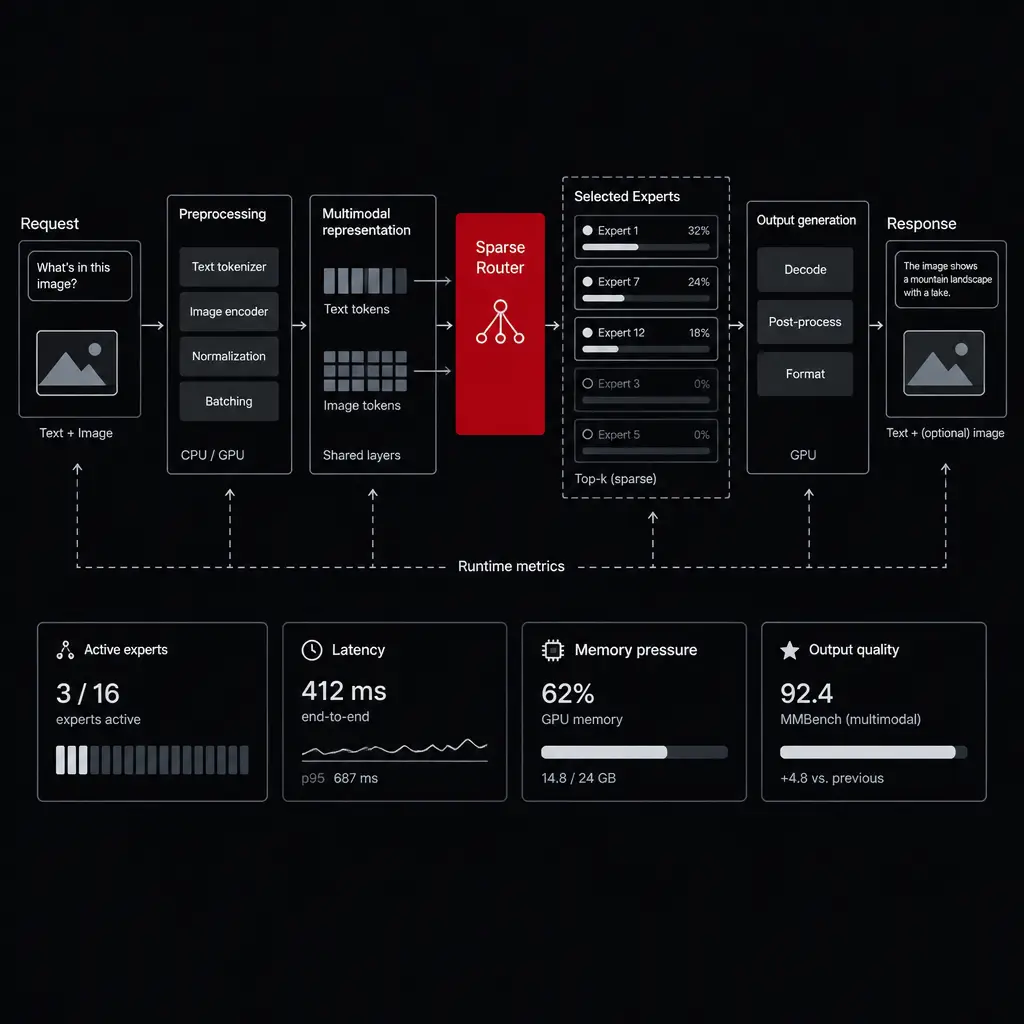
Measure latency and throughput under comparable batching. Report time to first token, inter-token latency, end-to-end latency, and completed tokens or requests per second. Test batch sizes and concurrency levels that reflect the intended service, and keep prompt lengths, output limits, image preprocessing, and generation settings aligned across runs. For multimodal requests, decide explicitly whether image decoding and preprocessing are included in the reported latency; excluding them can produce a misleading serving result.
Track resource behavior alongside speed. Record peak and steady-state GPU memory, host memory, GPU utilization, accelerator power where available, and memory pressure during loading and generation. For MoE execution, collect active-expert and routing telemetry when the runtime exposes it. Compare text-only and multimodal requests separately: image features, larger intermediate tensors, or uneven expert assignments may create bottlenecks that aggregate utilization hides.
Quality evaluation should be task-specific. Use exact-match or structured-output checks where the format is deterministic, automated metrics where they are valid, and human review for open-ended answers or visual interpretation. Check factuality, instruction following, grounding in the supplied image, refusal or abstention behavior, and consistency across repeated runs as appropriate. Report quality together with latency, throughput, and memory rather than treating a faster output as an improvement by itself.
Store raw prompts, images or stable image references, outputs, timings, resource traces, and configuration metadata. Keep warm-up runs separate from measured runs, repeat measurements to expose variance, and preserve failed requests instead of filtering them out. This produces a baseline that can support later changes to batching, precision, routing instrumentation, or serving infrastructure without confusing deployment differences with model behavior.
Questions Worth Testing
The preview is useful only if it turns architectural claims into measurable serving questions. Sparse activation is expected to reduce per-token compute relative to a dense model, but that does not automatically produce lower cost. Routing overhead, expert weights, communication, preprocessing, and low device utilization can erase the theoretical advantage. Measure end-to-end economics under representative concurrency rather than inferring them from the active-expert count.
Several hypotheses deserve controlled tests:
- Sparse activation may or may not improve serving economics. Compare total GPU time, memory footprint, throughput, and cost per completed request against a relevant dense or existing multimodal baseline. Separate prompt processing from token generation; their routing and batching behavior can differ.
- Routing may shape tail latency more than median latency. Requests that select different experts can create uneven expert loads, synchronization delays, or additional communication. Track p50, p95, and p99 latency alongside expert-load distributions. A favorable average can conceal overloaded experts and unacceptable tail behavior.
- Mixed modalities may introduce scheduling and memory bottlenecks. Image preprocessing, visual representations, shared transformer states, and expert weights all compete for memory and execution time. Test text-only, image-only where supported, and mixed requests with controlled input sizes. Determine whether the bottleneck is model execution, modality processing, transfers, or allocator pressure.
- Expert specialization may be fragile under distribution shift. Inspect routing and output quality across domains, image styles, languages, and task types rather than assuming experts remain balanced outside familiar workloads. Sudden concentration on a small subset of experts could affect both quality and capacity planning.
- Optimization choices need workload-specific validation. Continuous batching, quantization, tensor or expert parallelism, kernel selection, and accelerator placement can interact with routing. An optimization that helps dense layers may hurt sparse execution if it increases dispatch overhead or forces inefficient padding. Evaluate these choices with the same prompts, batch policies, software versions, and hardware.
The result should be a profile of observed behavior, not a conclusion drawn from the MoE label. The important comparisons are end-to-end: quality at a fixed cost, cost at a fixed quality target, and tail latency under the concurrency the service must actually handle.
Treat the Qwen4 Connection as a Direction, Not a Contract
Alibaba positions Qwen3.8-Flash-Next as an early preview of the architecture used in Qwen4. That makes the release useful for forward-looking engineering: teams can study the released model’s multimodal and MoE behavior instead of reasoning about an entirely unavailable design.
The claim does not establish Qwen4’s complete specification. It says nothing, on its own, about Qwen4’s final model configuration, release status, benchmark results, serving characteristics, or production readiness. The preview may expose architectural ideas that persist, but it does not guarantee identical interfaces, checkpoints, routing behavior, hardware requirements, or optimization opportunities in Qwen4.
Treat observations as properties of Qwen3.8-Flash-Next unless they are separately confirmed for Qwen4. A measured latency, quality result, memory profile, or compatibility finding is evidence about the released preview—not a promise about the next model. For engineering decisions, use the Qwen4 framing to prioritize experiments and track likely directions, while basing adoption decisions on reproducible results from the artifact actually available today.
Turn the Preview Into an Evaluation Decision
Qwen3.8-Flash-Next is worth evaluating now for teams with a concrete question to answer, not as a default replacement for an existing model.
- Model-serving engineers can test checkpoint loading, serving-stack compatibility, batching behavior, memory use, and the operational consequences of sparse routing.
- Multimodal application builders can measure whether its image-and-text behavior fits their workloads, including cases where visual inputs are incomplete, noisy, or outside the expected distribution.
- Researchers studying MoE routing can inspect expert utilization and routing stability where the available tooling exposes those signals, then compare them across text-only and multimodal requests.
Before adoption, collect evidence in six areas:
- Reproducibility. Record the checkpoint revision, runtime, kernels, serving framework, tokenizer and preprocessing versions, hardware, and precision settings. A result that cannot be reproduced is not a deployment result.
- Workload fit. Evaluate representative text, image-understanding, and mixed requests rather than relying on a generic prompt set. Include production-like input sizes, concurrency, and batching.
- Operational cost. Measure throughput, latency distribution, GPU memory, utilization, and scaling behavior under the same conditions used for current baselines. Sparse activation may reduce compute pressure without removing the memory and scheduling costs of a large expert pool.
- Failure modes. Test malformed or low-quality images, ambiguous instructions, long conversations, repeated requests, and concurrency spikes. Track routing instability, degraded outputs, timeouts, and behavior that requires fallback handling.
- Deployment constraints. Review the applicable license, checkpoint and dependency requirements, supported accelerators, quantization options, and restrictions imposed by the intended serving environment. “Open weights” does not by itself establish that every production integration is straightforward.
- Baseline comparisons. Compare against the models already used for the same tasks, with matched hardware and evaluation criteria. Report quality alongside cost and latency; a cheaper path is not useful if it increases correction work or reduces task success.
The result should be an evaluation record and a deployment decision, not premature standardization. Qwen3.8-Flash-Next can provide an actionable object for learning about multimodal MoE serving, while its preview role does not justify treating observed behavior as a guarantee for Qwen4 or committing a platform to it before the workload evidence is clear.
A Concrete Preview, Not a Promise
Opening the Qwen3.8-Flash-Next weights gives practitioners something concrete to run, profile, and challenge. That matters more than architecture diagrams alone: teams can test multimodal handling, sparse routing, serving behavior, and workload economics on their own hardware and data.
The Qwen4 connection gives those experiments strategic relevance, but it does not turn observed results into predictions. The useful boundary is simple: report what Qwen3.8-Flash-Next does, and treat claims about Qwen4 as forward-looking architectural context rather than a specification or performance commitment.
The next step is a controlled benchmark covering text-only, image-understanding, and mixed requests under documented software, hardware, batching, and precision settings. Inspect modality processing and expert utilization where the runtime exposes them. Measure latency, throughput, memory pressure, quality, and failure modes rather than relying on sparse activation as a proxy for lower serving cost. Share deployment findings, including cases where routing or multimodal scheduling becomes the bottleneck.
That evidence will show whether the preview is useful for a particular workload. It should not be used to prematurely standardize on the model—or to assume compatibility, capability, or production readiness for Qwen4.